
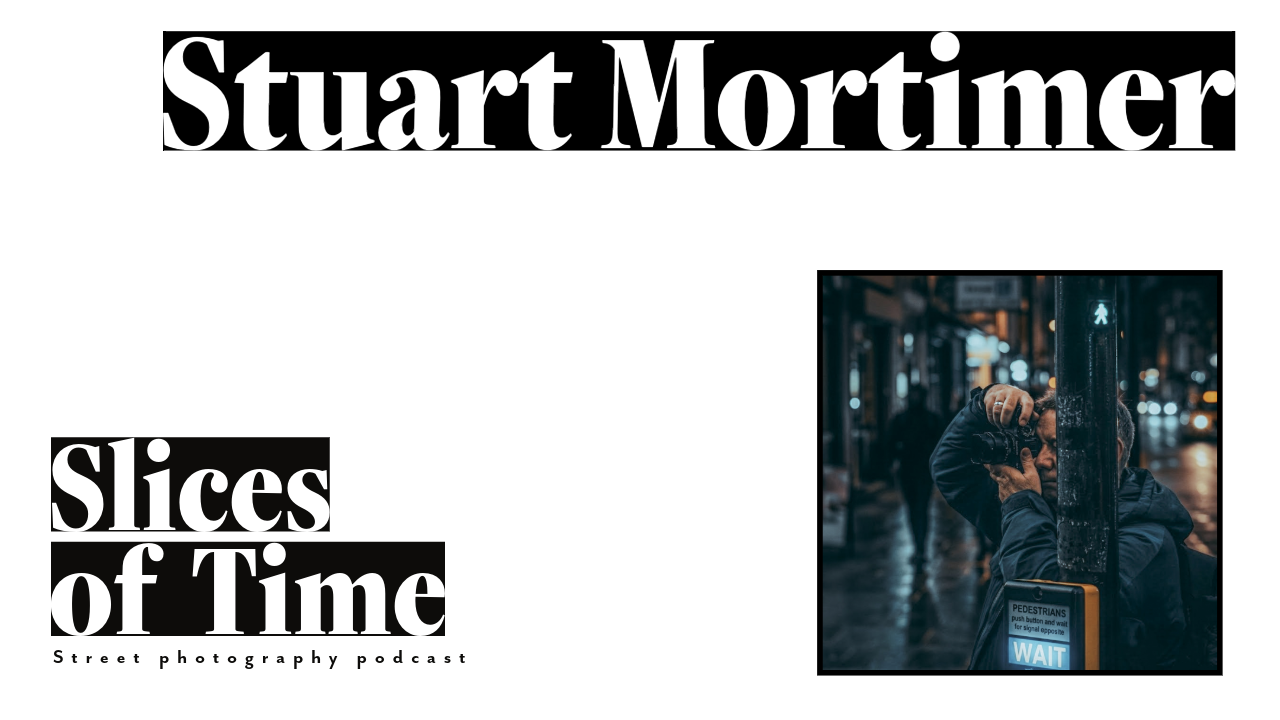
Today, I’m joined by Stuart Mortimer, aka BlueBeadyEye, a London-based street photographer. His work spoke to me because of the cinematographic quality to it.
Follow Stuart Mortimer:
- Website: https://www.bluebeadyeye.com/
- Instagram: https://www.instagram.com/bluebeadyeye/
Listen to the episodes on:
You can follow me on several social media for updates about the episodes:
- My website: www.fredericpaulussen.be
- BlueSky: https://bsky.app/profile/fredpaulussen.bsky.social
- Instagram: https://www.instagram.com/fredpaulussen/
Photographers, resources, and gear mentioned in this episode:
- La Règle du jeu
- Citizen Kane
- Saul Leiter
- Ernst Haas
- Fred Herzog
- Ernest Newman
- Joel Meyerowitz
- Garry Winogrand
- Joshua K. Jackson
- Jeremy Paige
- David Fincher
- Darius Khondji
- Matt Stuart (on Walkie Talkie)
- Paulie B
- Edward Hopper
- Mark Rothko
- William Eggleston
Timestamps for this episode with Stuart Mortimer
00:00 Introduction to Cinematic Street Photography
02:54 The Allure of Nighttime Photography
05:58 Influences and Inspirations in Street Photography
08:56 The Role of Color in Urban Photography
11:59 Daytime vs. Nighttime Shooting Techniques
15:00 Pushing Boundaries in Street Photography
17:51 The Importance of Patience and Waiting for the Shot
20:58 Technical Aspects and Equipment Choices
23:57 Finding the Right Locations for Shooting
26:56 Learning and Evolving as a Photographer
33:11 Exploring the Diversity of Street Photography
34:40 The Dynamics of Shooting Alone vs. Group
37:00 The Comfort Zones of Photographers
39:10 The Power of Observation in Street Photography
40:28 Empathy and Human Connection Through Photography
41:04 Day vs. Night Photography: Different Experiences
43:08 The Editing Process: A Photographer’s Dilemma
45:48 Instagram: A Platform for Exposure
47:31 The Influence of Hats and Style in Photography
50:29 Artistic Influences: Rothko and Beyond
Podcast Transcript
Frederic Paulussen Welcome to the Slice of Time Street Photography Podcast, a podcast where I explore the work of street photographers from around the world, across genres and visions. Today I’m joined by Stuart Mortimer, also known as Blue Beady Eyes on Instagram. He is a London-based street photographer whose work spoke to me because of its cinematographic quality. Stuart, could you introduce yourself?
Stuart Mortimer Thanks for having me, Fred. As you noted, my style is cinematic and nocturnal. I treat the urban environment as much as a character as the people themselves. I use muted colors and look for dramatic neon lights and moody weather to turn everyday city scenes into abstract art forms.
Frederic Paulussen I immediately noticed the nighttime, neon photography. Is that something you are naturally attracted to, or does it come from a practical standpoint since many people shoot after work?
Stuart Mortimer It was born out of necessity because I wasn’t finishing work until five or six o’clock, which was the only time I really had to go out and shoot. After doing it for a few months, I realized I am much more drawn to the city at night because that is when a city really comes alive. I learned quickly that day and night shooting require completely different styles. In the daytime you are chasing characters and people, but at night, I am after an atmosphere and a mood. When I was a kid, while others were playing football or riding bikes, I was sitting inside watching films like La Règle du Jeu and Citizen Kane. I have always been fascinated by films and scripts, and I loved seeing how directors and cinematographers translated those scripts into a visual form.
Frederic Paulussen Did I understand correctly that you have only been doing street photography for a few months?
Stuart Mortimer I have been doing street photography for about five years. I have had a camera pretty much all my life, taking pictures of my dog before I even knew what street photography was. While on holiday in Turkey, I was stuck in my hotel due to heavy rain and came across a YouTube video of a guy doing street photography. I thought it looked like fun, so the next day I took my little Sony camera to a street market, and from that moment on, I was all in. When I returned to the UK, I bought proper lenses and a new camera, read intensively, and studied all the best photographers to act as a sponge.
Frederic Paulussen Who were those initial street photography inspirations for you?
Stuart Mortimer I love the classics like Saul Leiter, Ernst Haas, and Fred Herzog. Hunting them down led me deeper to photographers like Ernest Newman, Joel Meyerowitz, and Garry Winogrand. Street photography is a fascinating and democratic art form because there is no single correct way to do it; everyone has their own style. That also led me to contemporary photographers like Josh Jackson, who is a big influence on my nocturnal work. Seeing incredible work from others acts as a drive to keep pushing hard.
Frederic Paulussen Did you immediately start with evening street photography five years ago?
Stuart Mortimer It came around later. When I first got back to London, I went to the South Bank for a couple of hours with my little Sony camera taking embarrassing photos from fifty meters away with a zoom lens. Still, it was fun because it felt like a switch was flicked and I was suddenly immersed in people’s lives. I have been going out two or three times a week for the past five years.
Frederic Paulussen Do you always go in the evening after work?
Stuart Mortimer Pretty much. I don’t go out much on weekends. We are currently in what I call street photography season because you have the weather, the darkness, and fewer tourists. Tourists are low-hanging fruit, whereas the real London characters tend to reveal themselves at night. Using both the characters and the city itself makes for interesting images.
Frederic Paulussen Do you look for typical Londoners or specific types of people?
Stuart Mortimer My main triggers are shards of light, little pockets of light, and the color red. Red is a recurring motif for me, and fortunately, London is a target-rich environment with plenty of it.
Frederic Paulussen London is great for that since it stays active at night. What attracts you so much to the color red?
Stuart Mortimer Our eyes are trained to see red as a trigger for emotions like love, anger, and danger. It is the first color we notice when looking at anything. Being in Chinatown or Soho at nine or ten o’clock at night, you see red everywhere, which creates fantastic contrast against dark streets.
Frederic Paulussen Do you shoot from 9 to 10 PM after work, or do you stay out late?
Stuart Mortimer I normally finish work at five or six, jump on a train to central London, shoot for three or four hours, and then go home. I chuck the files on my hard drive and forget about them for six months because I am pretty lazy when it comes to editing.
Frederic Paulussen We will definitely get into editing. Since you don’t work in the city center, lunchtime shooting isn’t an option for you?
Stuart Mortimer I used to work in central London and thought I would shoot on my lunch breaks, but it never happened because I rarely took a long enough break to devote concerted time to it. However, some of my best daytime shots were taken on my commute.
Frederic Paulussen You favor nighttime shooting, and looking at your portfolio, I only saw one daytime photo. Do you dislike your daytime results?
Stuart Mortimer I like being out, but the daytime requires a bolder mindset. At night, I can be five feet away from someone and go unnoticed, but in the daytime, you are much more exposed. I tried to push myself this summer to shoot during the day, take the shot, and deal with the hassle afterward. I have close to two hundred thousand pictures on my hard drive, most of which are daytime shots that I have never even looked at. On Instagram, people have an expectation of your style, and I haven’t posted daytime stuff yet because I am not sure what reception it will get or if I am completely happy with it. I am still trying to perfect my daytime shooting, leaning toward deep, contrasty shadows which fit my style better.
Frederic Paulussen What moved you to start practicing more up-close daytime photography?
Stuart Mortimer It might be controversial, but most of us only display our work through Instagram, and we are guilty of living in a bubble where everyone posts the same shots. To push ourselves, there is a void for pushing the genre forward with crazy shots people wouldn’t normally dare to post. I have photos I wouldn’t dream of posting right now because they are too close to the knuckle. I am a huge fan of Jeremy Paige (Eaten by Flowers on Instagram); he gets incredible shots that no one else is taking and worries about confrontations afterward.
Frederic Paulussen I will have to check out his work. Did seeing these different styles inspire you to try them?
Stuart Mortimer Definitely. I admire Garry Winogrand and recently got one of his books. He gets right into interactions with people. I look for those interactions during the day, but it requires getting over the fear factor of going up to someone just a few feet away. Once you cross that boundary, it becomes comfortable, but stepping over the line is the real challenge.
Frederic Paulussen I found it easier to shoot up-close in London than in Antwerp because you can hide in the crowds. But if I stop practicing for two weeks, I lose my rhythm.
Stuart Mortimer I find the same thing. If I go on holiday for two weeks, it takes me three or four outings to find my rhythm again. Even on a normal night, it takes me up to an hour to warm up and get in the zone. When I am not in the zone, it feels terrible, but when everything falls into place, it is magic.
Frederic Paulussen Do you know immediately when you capture a great shot, or do you only see it afterward?
Stuart Mortimer Because my early influences were films, I think visually. At night, I visualize a film set, line up the light, and wait for a person to walk through. Once I take it, I feel it matches the picture in my head, but obviously I don’t know for sure until I view it at home.
Frederic Paulussen Your iconic photo of a man’s silhouette through a plastic sheet with green and yellow—did you know you had it in the moment?
Stuart Mortimer That was a complete accident. My Fuji’s autofocus failed while trying to focus on the guy behind the sheet, and the focal point landed on the plastic instead, creating the abstract image. Some of the greatest pictures are happy accidents.
Frederic Paulussen Those happy accidents teach us to rethink our approach. Do you frequent the same areas in London for good light?
Stuart Mortimer I shoot in central London: Chinatown, Soho, Piccadilly, Oxford Street, and Mayfair. During the day, I might go to Brick Lane or Oxford Circus.
Frederic Paulussen Are you patient enough to wait for the right moment?
Stuart Mortimer I didn’t think I was, but people tell me I am very intentional. When I am alone, I am much more focused and slower. For a silhouette shot in the rain at Piccadilly Circus, I stood on a traffic island for an hour getting completely drenched just waiting for a woman with an umbrella to walk through. I caught a cold for a week, but that was exactly the image I had in my head.
Frederic Paulussen Do you often emulate the cinematic style of the movies you love?
Stuart Mortimer I take motifs from them. I am a huge fan of David Fincher and cinematographer Darius Khondji, who shot Seven using muted styles, Dutch angles, and silhouettes. I steal a lot of his ideas regarding angles and color schemes.
Frederic Paulussen Do you frequently wait long for a photo?
Stuart Mortimer When I am on my own, I can wait on a street corner for ten or fifteen minutes. Street photography is a patience game. As Matt Stuart said, ninety-nine percent of it is failure, but the moments that do occur make the suffering worth it.
Frederic Paulussen What kind of lens do you use?
Stuart Mortimer I use a 56mm on my Fuji, which is roughly an 82mm equivalent. I prefer a longer focal length for details and isolation when shooting wide open at night. I recently bought a 28mm for daytime shooting, which will be my challenge for the next year.
Frederic Paulussen Street photography has such a wide range of possibilities, which is why I started this podcast to explore them.
Stuart Mortimer It is almost impossible to define. If you ask a hundred street photographers what it is, you will get a hundred different answers.
Frederic Paulussen Do you ever go on photo walks with others?
Stuart Mortimer Not often. During group photo walks, you end up doing ninety-nine percent talking and one percent shooting, which results in gigabytes of rubbish. I have a small group of friends I shoot with, but I split my time fifty-fifty between shooting with them and going alone.
Frederic Paulussen Do you notice you have a comfort zone of places you stick to?
Stuart Mortimer If you spend enough time in any place, you get to know where the good shots are and where the characters hang out. Taking up street photography opened my mind to noticing everything going on around me.
Frederic Paulussen I find it makes you realize how unaware people are in the streets, but they are still generally good-natured. Sometimes people try to be helpful and move out of the way, which ruins the shot.
Stuart Mortimer Exactly, sometimes you want them to keep walking and be part of the frame. It has definitely made me more attuned to how people react and more empathetic.
Frederic Paulussen Are people less comfortable with a photographer around at night?
Stuart Mortimer I find they are actually much more wary during the day because you are exposed, whereas at night the darkness acts as a cloak.
Frederic Paulussen You mentioned leaving your photos on a hard drive for six months. I usually export mine the same evening. Do you just dislike editing?
Stuart Mortimer I genuinely hate editing. I have pictures from Istanbul in April that I still haven’t looked at. My long-term plan is to turn my travel photos into a book because they don’t fit my regular Instagram style.
Frederic Paulussen How important is Instagram to you?
Stuart Mortimer It gives me a platform to show people what I can do and acts as a stepping stone for projects like books. While I post pictures I like, it is more important to me that the audience loves them. It is entertainment, and I want people to enjoy the work.
Frederic Paulussen You often photograph men in hats. Do you wear one yourself?
Stuart Mortimer I do wear a hat. Hats are a visual trigger for me, giving scenes a timeless feel reminiscent of the fifties and sixties. A busy, rain-soaked street scene with a man in a suit and a woman in a red dress carrying umbrellas is my idea of heaven.
Frederic Paulussen Do you keep a folder of favorite photos you know won’t work on Instagram?
Stuart Mortimer Yes, there are pictures I shoot strictly for myself or hold back for special projects. I am currently working on a project about launderettes.
Frederic Paulussen Are paintings an important influence for you?
Stuart Mortimer Hugely. I am a massive fan of Mark Rothko’s work, particularly his use of ambiguity, darkness, and big blocks of red color. I subconsciously try to incorporate those themes into my pictures.
Frederic Paulussen Saul Leiter and Mark Rothko definitely intersect there. Do you like Saul Leiter’s paintings?
Stuart Mortimer I prefer his photography and think he was a better photographer, but I do enjoy his art. I am also going to a William Eggleston exhibition in Soho soon.
Frederic Paulussen That makes total sense given your shared affinity for the color red. Does your dog ever join you on photo walks?
Stuart Mortimer No, he walks too slowly and would just stand on a corner sniffing for hours.
Frederic Paulussen Thank you for your time and insights, Stuart. I will link your Instagram and website in the show notes for anyone who wants to see more of your work.