
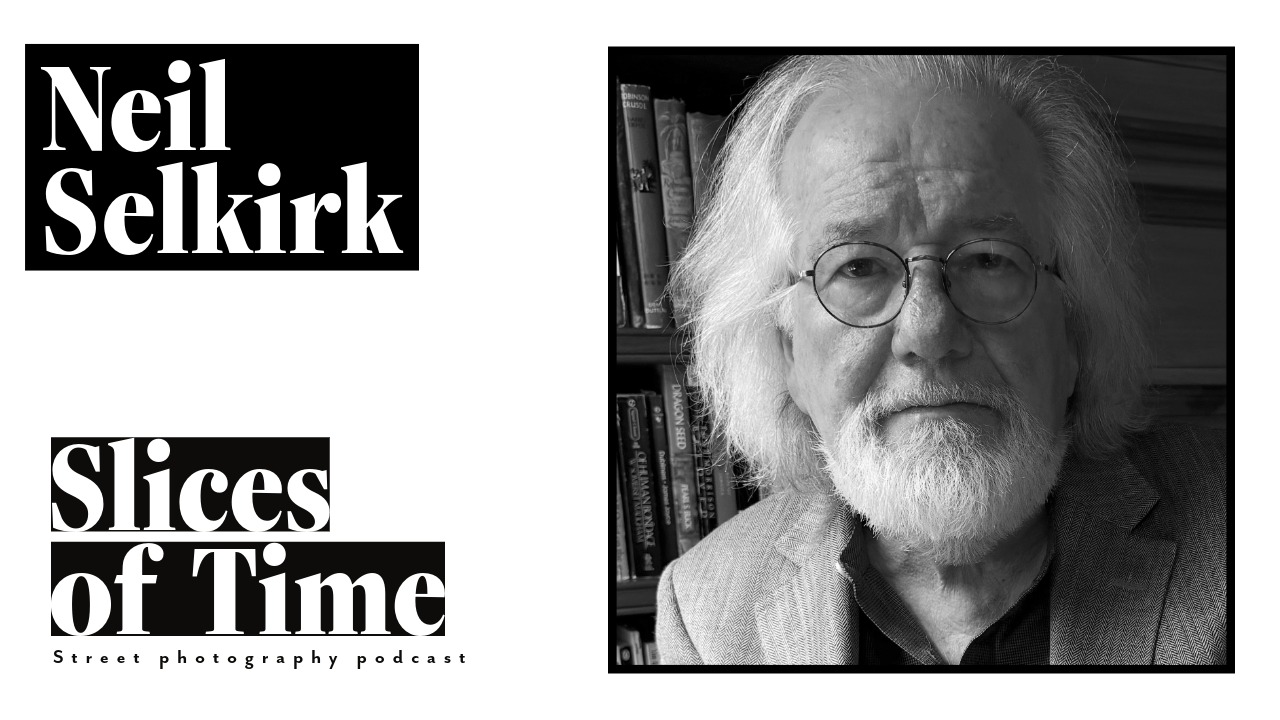
Today, I’m joined by Neil Selkirk, a New York photographer. He just published his book, Why Photographs? He worked together with some legendary photographers like Richard Avedon and Diane Arbus.
Follow Neil Selkirk:
- Website: https://www.neilselkirk.com/
Listen to the episodes on:
You can follow me on several social media for updates about the episodes:
- My website: www.fredericpaulussen.be
- BlueSky: https://bsky.app/profile/fredpaulussen.bsky.social
- Instagram: https://www.instagram.com/fredpaulussen/
Photographers, resources, and gear mentioned in this episode:
- Why Photographs? Book
- Richard Avedon
- Diane Arbus
- London College of Printing
- Irving Penn
- Hiro
- Marvin Israel
- Gary Winogrand
- Lee Friedlander
- Ruth Ansel
- Niepce
- Fox Talbot
- Tibor Kalman
- Yolanda Cuomo
- David Zwirner Gallery
- Ekphrasis
- László Moholy-Nagy
- Walter Benjamin
- Siegfried Kracauer
- John Szarkowski
- Tournachon/Nadar
- Julian Barnes
- Dorothy Lang
- Ted Orland
- Ansel Adams
Timestamps for this episode with Neil Selkirk
00:00 Introduction to Neil Selkirk and his work
02:53 Street photography in the 1960s and iconic moments
05:55 The philosophy of capturing the moment in street photography
08:55 The role of chance and environment in authentic photography
11:59 Creating a sequence and the inspiration from Avedon
15:57 The series on security locks and finding beauty in everyday objects
20:02 The importance of authenticity and the camera’s role
23:53 The significance of the physical camera and process
28:01 Neil’s approach to working with subjects and environment
31:57 The importance of the photographer’s philosophy and mindset
35:51 The history and influence of photographic writing
39:53 The camera as a tool for discovery and seeing
41:52 Teaching and experiments in capturing the unexpected
43:53 The importance of knowing when to let go of control
45:49 Neil’s thoughts on equipment and camera choices
47:54 The versatility of different cameras and their influence
49:46 The influence of Avedon and Arbus on Neil’s style
51:42 The evolution of camera choices and working methods
53:56 The series on locks and everyday objects
55:55 Closing thoughts and where to see Neil’s work
Podcast Transcript
Frederic Paulussen (00:01) So welcome to the Slice of Time Street Photography Podcast. A podcast where I explore the work of street photographers from around the world across genres and visions. And today I’m joined by Neil Selkirk, a New York based photographer. And he just published his book like last week or two weeks ago, I think, Why Photographs? And he worked together with some legendary photographers like Richard Avedon and Diane Arbus. But today we’re gonna focus mostly on his own work and on the book. So hey, Neil, could you perhaps introduce yourself?
Neil Selkirk (00:30) Hi. Okay, so I’m Neil. I was born and raised in England and I got interested in photography, I guess, in high school and wound up going to the London College of Printing, which is one of the better photography schools in the UK at the time. And in my final year there, one of the teachers who’d just come back from New York said, if you really want to know how photography’s done, you have to go to New York. So I wangled and finagled the fair and somebody whose floor I could sleep on as it were and went to New York and got a number of amazing jobs with American photographers offered right on the spot. And I came back essentially with the gig as being Richard Avedon’s assistant when he was in Europe.
In the meantime, I was shooting on the street all the time. In fact, it’s essentially the only thing I shot. And I had an incredible three weeks in New York in the spring of 1968 when an incredible number of political things happened. Martin Luther King was assassinated. Lyndon Johnson withdrew from the presidency. I ran into, I’d gone for an interview with Irving Penn. And I came out of his studio and walked right into Bobby Kennedy, who just announced that he was going to run for the presidency. I mean, was just an extraordinary time. And the pictures were terrific, actually. The sort of shock of running into America in New York was colossal. So then I came back. Avedon worked a shared studio space with Hiro.
And I came over, they brought me over to be Hiro’s assistant, which I did for a couple of years. And at that studio, Diane Arbus and Marvin Israel, who’s an incredibly important figure, art director and painter, and friend to an extraordinary number of photographers of that era, Gary Winogrand, Lee Friedlander, and many others, but was frequently at the studio. And one of my first tasks was Diane was looking to change format from two and a quarter. She’d switched from 35 to two and a quarter 10 years before and she was looking for a change. And Hiro had the first Pentax six by seven camera that ever arrived in the States. Pentax gave it to him. And Diane was researching larger format 120 cameras.
Hiro agreed to lend it to her and I got to show her how to use it and And then once she decided she thought it was the answer to her needs. She had to pay for it and didn’t have any money So she decided she’d have a class and would we assistants go to the class and we all sort of said yeah sure and so then she did her class which has become the last master class and And then she killed herself.
And then I got very involved with researching all her negatives and work and printing for a huge retrospective show in 1972 at the Museum of Modern Art, which was incredibly important, where she was sort of introduced to the world for the first time and shocked the world. then that was all over and then I needed to make a living. I by this time decided I was staying in the States, know, was too great. England was part of my history at that point. And so I started working for Esquire magazine where Diane had worked. And then I went to the New York Times magazine to show my work. And I showed this portfolio of photographs, of glossy magazine photographs of various things, but mostly illustrations of ideas of fishing, of congressmen doing karate, things like that. And the art director, Ruth Ansel, was sort of unimpressed. And then she saw some prints sticking out of the back of my portfolio and she said, What’s that. And I said, it’s my street photography. And she said, what can I see? And I said, of course. And she went through it and she said, this is great. Will you shoot this for us?
And so I wound up doing street portraits, essentially, a lot of politicians. I sort of became the go-to guy for the New York Times Magazine doing politicians in the 70s. And they were all just outside on the street. And then I had a family, need to make money, did more commercial work. And with always… doing a fair amount of editorial work and mostly portraits and mostly on the street. And sort of that continued.
Frederic Paulussen (05:56) Yeah, and I think that’s very cool because I noticed the street portraits and I mean they are posed but they’re still always on the street and especially with these important figures. Was it easy to get them out on the streets for you or was it because it’s off maybe often these politicians are maybe more protective of their surroundings of their image?
Neil Selkirk (06:21) Very much so. They are very protective. But I can be persuasive. mean, you can always… I mean, it’s what I wanted to do and I believed in the pictures and them being in a real environment, but you are absolutely right. I remember saying to a young politician who was with his father, who was a very established politician, you know, want to do it out on the corner on Park Avenue. And his father immediately said, you’re not a Park Avenue candidate. meaning you’re not from the upper echelons. And so you can’t do it in Park Avenue. So thought, we’ll do it on the street, which was like 15 feet away, but that would satisfy everyone. You’re absolutely right. They’re very sensitive to that stuff. But because of some of the stuff that is very relevant to what I say in the book, you know, one hears about other photographers and everybody has their own way of doing things, you know, spending hours trying to find the perfect background, the perfect spot in which to pose their subject. And my position always was, when I was talking to the subject, that the best place to take the picture is right here, right now, without even looking at the environment and allowing the credibility of what I had just said to impose itself on the photograph.
So no matter where I was, like if it didn’t matter, I mean, it wasn’t the bathroom, but it was just about anywhere else. I would just do it there and make a picture there. And it served me incredibly well. It gives the pictures an authenticity because, you know, why on earth did he take the picture there sort of thing immediately comes to mind when you look at the photograph. I mean. I was careful. Once I decided we were going to do it here, now, I turned it into a photograph so they don’t look bad. But it was a real philosophy that really worked for me.
Frederic Paulussen (08:33) And how did that philosophy come about? Was that something you evolved over the years? Was it something that already was in your childhood maybe present? Because I think the philosophy behind photography is important because that’s how you get your style usually. So that’s why I’m curious where that came from.
Neil Selkirk (08:56) It really, when I was at photography school, I had this mania that photographers have. In other words, you have to photograph all the time. And I photographed all day and I was in the dark room all night. I never slept. I just had to do it and do it do it do it. And sort of became aware, and it became stronger and stronger the more experienced I was, that it’s the… the chance elements in the photograph that give it its credibility. I just embraced whatever there was, always, in every way. I’m not answering your question. What was the question?
Frederic Paulussen (09:44) I think you are. The question was where did that philosophy came from? I already like I hear the it’s kind of like a street photography philosophy is about like it’s just about where you are documenting what you see embracing the the
Neil Selkirk (09:57) Yes, the camera sees them. I say in the introduction to the book, the camera sees all this stuff and and Niepce knew about this. Fox Talbot knew about this and it was subsequently suppressed that the camera sees everything you see, almost nothing. You see what you’re looking for. And if you allow the camera to to to let rip and see what it wants to see. What it does see is so often so much more amazing than what you thought you saw yourself. I mean, possibly the best set of pictures I ever took. I took on a super wide Hasselblad with no viewfinder on it. Instead of the viewfinder, I a flash gun. There was nothing to look through. So you just sort of stuck the camera at the subject and let the camera decide what was going to be in the picture.
And the pictures are just, I mean, when I first saw them, when I processed that film, I thought, damn, didn’t work. And I didn’t look at them again for five years. But then I went through them. I said, wait a minute, you know, actually these are amazing. And it was because it wasn’t what I would have done if I’d been controlling it. But it’s what the cameras sort out. or simply documented when I didn’t know what was going on. And it was spectacular.
Frederic Paulussen (11:26) Yeah, yeah, and I think these little moments by, well, it’s controlled chance, like it’s not entirely chance, I think those make a photograph a lot more interesting. For example, I have here a photo of Andrew Motion. I think it’s on Trafalgar Square that you made it.
Neil Selkirk (11:45) Yeah, that’s right. It’s in London. Yeah.
Frederic Paulussen (11:46) Yeah, and you have this beautifully well lit… portrait of him but in the background there’s this woman looking back at him and I think you wouldn’t get that if you would stylize the sets too much and yeah exactly
Neil Selkirk (12:00) She sort of makes the picture. It’s like something’s going on. And she saw that there was something going on and she’s telling you that there’s something going on.
Frederic Paulussen (12:08) Exactly, and I think that’s a way to, well, first of all to get street photography into your, even your post portraits, but it makes the image more interesting exactly. If the stairs were just empty, that would be a guy in a suit on a nice stairs and it wouldn’t say too much, I think.
Neil Selkirk (12:28) Yeah, I mean, a really good example, I don’t know if it’s late, it’s in there somewhere, of Zbigniew Brzezinski when he was the national security advisor in the White House. And so he’s at the White House. And I’m photographing a senior government official at the White House. And I said, I’ve got a spot downstairs outside. And he said, sure, let’s go. And we went down there and there were a bunch of kitchen workers cleaning out the stainless steel pots from a banquet or something the night before in the background. But you can see the portico of the White House behind them. So you know you’re in a sort of private working area of the White House, but you’re at the White House and it’s him. And the picture just has cred. This is more like the real world of the working politician. Sometimes I went the other way and just made them look like they wanted to look like as the important politician. But it was an awful lot of fun to show them in the real world.
Frederic Paulussen (13:36) Yeah, and so with these two examples on Trafalgar Square and in the White House especially, did you like do some scouting in beforehand? Because I can imagine, well, Trafalgar Square of course is a public terrain so you can a day ahead or a few hours in advance, but I can imagine the White House being even then a bit more strict.
Neil Selkirk (13:58) Yeah, that’s actually very, and I do remember after I took the picture, I thought, great heavens, this is not what they’re expecting. And I felt bound. And I called the press guy that had set the shoot up. And I said, look, there’s some… there are people in the background who are working the kitchen stuff. And he fortunately was not very experienced and said, sure, that’s no problem. And he didn’t even look at the picture. So that was fine. I don’t know how we wound up. That’s on the steps of the National Gallery in London. That picture was taken. I may have agreed to meet him there, in which case we probably met on the steps. And I said, right here, right now. And boom, there it went. I mean, I’m much more likely to spend the prep time on what the image is going to look like from a technical standpoint than I am choosing the location. There’s a picture of Robert Altman, the film director.
And I did that for Marvin Israel, the guy I mentioned who is this extraordinary art director and friend of photographers. And he called me up and said, I want you to shoot Robert Altman. And I said, goody. And he said, I want you to consider concealment. That was his directions. And I went nuts for two or three days with my assistant trying to figure out what concealment might imply or look like. And we wound up shooting him in a car just and the only sharp thing in the picture is his eyes. And I did that by putting a portable flash gun behind the car pointing forwards at the mirror. And then I just said, make sure you can see the flash gun. And he looked and he got his eyes lined up so he could see the flash gun. And then I sort of waved the camera while I took the picture, which made the car look as if it was moving, which it wasn’t. And that was incredibly carefully done, meaning I knew exactly the shutter speed had to be one second. I had to move the camera in a certain way for it to get exactly that amount of motion, meaning I knew exactly before I took it what the picture was going to look like.
In fact, we got there and started setting up and it was way too light outside. And of course, he’s a film director. He understands this stuff. And I went upstairs to his hotel room and said, look, we’re all set downstairs, but it’s way too light. Can you wait a bit? He said, sure. So I said, I’ll come and get you when the light gets right. And that’s what we did. Yeah, that’s right. It’s helpful. Not everybody would do that.
Frederic Paulussen (16:44) No, you can’t do that with a politician who has an important meeting right after or who doesn’t understand that it takes some time.
Neil Selkirk (16:53) It paid off for him too.
Frederic Paulussen (16:58) And so with the that’s a politician portrait and I think there’s a very interesting project you did at the start of the century I think it was 2001 or 2? no 1998 even. Which is called 1000 on 42nd street which I think is Studio photography, but at same time it’s also street photography. I think there’s this funny intercept between those two, because I’m gonna explain that the concept may be just how I experienced it, So it’s basically you photographed 1,000 people on, I read somewhere two days, but that seems crazy to me. Okay, that’s lot of, that’s… Okay.
Neil Selkirk (17:39) Yeah, yeah, yeah, yeah. That’s a lot of people. Actually, the second day was relatively slow. mean, I don’t know. is so a friend, the client as a designer called Tibor Kalman, the whole area of Times Square in New York, which is a sort of tourist epicenter of New York, was being rebuilt. I mean, they pulled down dozens of buildings and built the whole thing and. T-Boss was sort of design advisor to the whole project. And he said, okay, so all these construction sites are gonna have huge fences around them. Why don’t we decorate the fences with portraits of people who would normally be seen on the street there? And so he came to me and what we did, it involved sort of factory photography. We had two or three or four nice young people approaching people as they walked by and said, you know, we’re doing this wonderful project. We’d love to take your picture because we’re going to make posters and put them up all over the place. So they would then lead the person who was sort of baffled but interested to a table where they would sign a release, which was interesting. It sort of folded into it. was long and thin. then so the first frame of each person, when we did it, they held this up so that there was a picture of them with their signature.
and with their name and why they were on in time square. I had a set up and it had to work from dark through sunshine, through rain, whatever happened. It had to be right there and it had to work. And we set up a large picture frame, like yay big, 20, 24 inches. And it was mounted there. And what we did is that’s where I, and it was the right height for me to take the picture. And I had an assistant who looked at the person, decided how high they were and put a platform to bring them up to the center of the frame. So the person knew exactly where they needed to be. In fact, I encouraged them to hold on to the side of the frame and that put them in the frame in their own mind.
And so they were in exactly the right place. And depending on the light, we could either diffuse sunlight or when it got darker, use strobe or just let it be whatever it was. If it was gray, we let it be gray. And there was everything happened in those two days. And I would just welcome them, stand there and. 30 seconds, boom, boom. And they got into it. There was a sort of there was an air of a festival about the whole thing. were a lot of people. We probably had 10 or 15 people in the crew and they were all having, we were all having a good time and the people were all having a good time. the people just sort of managed to be themselves. And when it was finished, I said to Tibor you know, this is too good. We have to make a book out of this. And so we did. It was, no, it was pictures of them on posters on these construction hoardings. And that was a love.
And they were real people, never expected when they got up in the morning to have their picture taken. Although, Thibaut arranged with a PR outfit to get in touch with a bunch of famous people and see if they would like to be in it. And so Oscar de la Renta is in it. Tommy Hilfiger is in it. And a lot of other literary celebrities and so on who aren’t identified in the book except by their first name. So that there are actually a bunch of famous people in there. And because I’m completely ignorant of famous people and stars, I don’t know who anyone is. I don’t have a TV. And so don’t know who anyone is. And so what they would do is when they had to sign the release and they would put a couple of big stars on the release. So when they held it up, I knew they were famous. Now only when they held this thing I thought, okay. But that was fun and it was real people. And that was what was great about the book. The book sold really well. It was in the Museum of Modern Art for years because it’s such an art. It’s just ordinary people being. that was, it was lovely. It’s a really nice project.
Frederic Paulussen (22:22) Yeah, and I think it really shows the range of people visiting. I see like you have a photo of a kid and then you have like a baby and then photos of all types of people, which I think is interesting.
Neil Selkirk (22:37) A fire truck pulled up beside us and all the firemen got out and had their pictures taken. It was really a sort of festival, come get your picture taken.
Frederic Paulussen (22:49) That’s so cool, because I was wondering like at some point, but of course you had the assistants doing it. I was wondering if at some point it became a more selective process because you’ve maybe got sick of the 10th guy in a blue suit with specific hair. Okay, cool.
Neil Selkirk (23:04) We just took everyone. We just took them all. And what you see is what you got. know, they I mean, literally. obviously, there must have been a selection. The book, I think, has about 350 full pages. The wraparound jacket has all thousand. But inside the book, we probably we probably took one out of three. So there definitely was a selection process in the end.
Frederic Paulussen (23:24) yeah. then for a book that big, I start to wonder because it’s all in a wide background. So it’s all very person oriented, of course, because that’s a project, just the people without the surroundings, even though it’s on 42nd Street. But how do you start making a sequence for the book? Because it’s, to me, it’s, and I did find some… It feels kind of inspired by Avedon’s work as well, because he as well does the white background. So did you look at him for sequencing this project as well, like inspiration there or?
Neil Selkirk (24:08) No, not for sequencing. I don’t even remember how we did the sequencing. I worked with Yolanda Cuomo, who’s a super good book designer, who actually worked out of my studio. I mean, her studio was in my studio, and so we were very close. I do not remember how we sequenced. It’s one of those things where you just, you don’t want anything to be too alike. You just, you know, just… make them work somehow, but jiggle them. But the white background thing was really interesting. It’s funny you should mention it because I’d forgotten. Because initially when Tibor said, I think we agreed it was going to be a white background. he, I was trying different lighting ideas to make it essentially studio lighting. And Tibor had put together a dummy, a full-size dummy of what the billboards were going to look like when they were done, which was sort of a couple of meters high and a meter and a half wide. And the one that he did was not my photograph. And I was going to say it was an Avedon, but it wasn’t. But it was a picture of a guy.
a worker of some kind and that I hadn’t taken and it looked great. And I thought, that’s what I want, but I’m not getting it. And I realized that what they’d done is they’d used daylight, available light, and then stripped the background out and made it white. And so that was the moment when I decided that I wanted daylight for these pictures. except that we had behind them a backlit white background, unfortunately I had really, really experienced, really good assistant because it was really important to constantly keep the background to the right brightness so that it would be exactly right behind whatever was going on on the person’s face. But they knew exactly what to do. We’d worked together long enough. that we knew exactly how to get what we wanted. But they are actually mostly, until it got dark, they’re mostly daylight, whatever form of daylight there was. And that quality, which is the street quality in the pictures, was the light that they were actually confronted with out there that day. And that gives a credibility to the picture, looks like it’s studio, superficially looks like a studio photograph, but the credibility comes from the fact that it was taken on the street.
Frederic Paulussen (26:54) Yeah, exactly. And I think also that’s, I think how Avedon worked a lot, just the background and just use the natural daylight, which I think is great.
Neil Selkirk (27:04) laterally, like the American West and stuff like that. Yes. Yeah. Yeah.
Frederic Paulussen (27:07) Yeah, and so I know you two worked together or you assisted for him and you came in contact with a lot of these great photographers like Diana Arbus as well. Did those contacts influence how you saw and worked a lot or was it more sometimes in the details? Because I feel like you came to New York with already has fairly specific mindsets maybe or philosophy.
Neil Selkirk (27:40) which was then blown apart, right? Well, see, when I first came to New York, I hadn’t worked in London. I was still at photography school. I was in my final year of photography school when I came to New York. And that’s when I got the job for Avedon and I worked for Avedon that summer and I still hadn’t worked in London yet. thinking about Avedon and Arbus, what my pictures derived from each of them has much more to do. Diane never worked with an assistant. She always worked alone, completely alone. And she processed her own stuff and she printed her own stuff. You she never had help making the pictures. So nobody really, nobody was ever. around when she was taking pictures. I mean, I once saw her on Easter Sunday, walking down the Easter parade, we greeted and said hi, and she said something about hating all these people who only show up to have their picture taken. But I mean, she was just walking down the street. Dick, on the other hand, worked with a lot of people. But it was their photographs that influenced me. I came out of photography school in New York as a very, as a, not capable for heaven’s sake, but as I was trained to be a magazine or advertising photographer. That was all, right,
Frederic Paulussen (29:06) Okay, that’s what you got taught in school, yeah.
Neil Selkirk (29:08) all the images in my head had to do with pictures that would sell either to directly or either advertising or magazine photography. And then I came to New York, I worked for a couple of years in the fashion world as an assistant and then, The whole Diane thing came into my life and then I wind up spending a year looking at every photograph she’d ever taken so that I could find the negatives so that we could print them for the exhibition. And after a year, I was unemployable because I couldn’t take a picture that wasn’t authentic. You the whole idea of fabricating an imaginary reality was just completely alien to me at that point. After a year of being immersed. in her photographs. So that was enormously influential. mean, far more than the class that we did with her, which is like 12 classes over two or three months, was just being immersed in her work and being unable to not sort of essentially be sort of honest in a way. And it took a long time to recover from that so that I could actually make a living.
Frederic Paulussen (30:19) Yeah, because I can imagine because you’re the only person in the world who is allowed to make prints of her work. And I read you do it exactly like she would have made them. And to me then it becomes, well, to me the question rises then, is it still? possible for you to detach from that process and do your own things or does that process become inherently part of you?
Neil Selkirk (30:53) Yeah, that’s interesting. Years ago, I was talking to her daughter, Doon about this. And Doon had worked for a very long time for Richard Avedon. And so also knew them both really, really well. the sort of notion that I came up with was that Avedon photographed people to see what he could get out of them. Diane photographed people and it was about what they gave to her. And in terms of where I was going to sit in all that, I tended, I thought, with my magazine work to try and photograph people as they imagined they would like to be seen, which I thought was an absolutely… Because as Diane said, you know, the difference between intention and effect. You get up in the morning, you put your clothes on, you look in the mirror. And you say, okay, out I go. And you go out onto the street and you don’t actually look anything like what a picture of you would look like. Meaning what you think you look like or who you think you are being is terribly flawed. You’ve made a mistake. And it’s the degree to which you’ve made a mistake that is interesting. And so I was sort of playing absolutely to the mistake.
And she was totally believing in the person who’d made the mistake and they believed in her. Dick was driving people to be amazing looking. She was just waiting to see, because they were reacting to her absolute ability to make them feel legitimate in themselves. And then she just took a picture of that because they were willing to share it with her, which is, you know, totally polar opposite approach. But yeah, I mean, you certainly I think when, one is learning in, in particularly sort of at the feet of a master, you can’t do much, but start out imitating them. I mean, because you see how they work and you just sort of do the same thing. And it’s how. It’s in what way you diverge from their practice that becomes you. And I don’t think it’s something you can really control. You’re doomed. I I took pictures in Diane’s class that were just horrible imitations of her photographs. And lots of people tried white background stuff and tried to do the Avedon thing. But again, he was extraordinary. in his ability to make people feel that it was time to outdo themselves.
Frederic Paulussen (34:04) Yeah, I think that’s great. one thing that also comes to mind and this is, of course, you have this working with the masters following their classes. But you, of course, you just made or published a book, Why Photography, which is about the essays. So I think which is. It’s not necessarily as following a class, but it’s really about the inner. inner thoughts of these these grades do you find well first of all you have all these essays in the book I’m not sure how recent most of them are but I feel the photography essay is kind of a lost art form if that’s fair to say
Neil Selkirk (34:56) Hmm. That’s intriguing. so originally I didn’t decide I wanted to do this book. I was asked to do it by my house in New York is right next door to the David Zwirner Gallery, and it’s a very big gallery and they have a publishing arm. And I know lots of the people there. And one day somebody called up and said, we have this imprint called ekphrasis which I know well. They’re beautiful little books, they’re all about… ekphrasis is writing about art without illustrating what you’re saying. And so it’s a whole slew of books, 40 or 50 they’ve done already, where somebody introduces a little known piece of writing about a topic and then writes about that piece of writing and they publish both. And so I jumped in and of course I did it with 35 different authors and they said, no, no, it has to be one author. So they didn’t publish it. So somebody else is going to publish it. But where are we going with this?
Frederic Paulussen (36:04) about it being a lost art of the essays. Yeah.
Neil Selkirk (36:07) Right, right, I think that’s a very interesting idea. Something that I immediately, I bought, I bought dozens of books and started reading them about photography. And I had this huge pile all along the living room wall of books. And most of them weren’t what I was after, and some of them were. And some of them, I’m going right back, the oldest ones are from the… 20s and 30s, was Moholy Nagy’s widow wrote a book. And then there was people like, well Walter Benjamin is incredibly well known, but Siegfried Kracauer, who was writing at the same time, who was mostly writing about film theory in the 1930s in Germany, he wrote some pieces about photography. And that’s probably the oldest piece that’s actually in the book. But the other thing that struck me was introductions to photographers own books of photographs, which so often don’t get read. Meaning you buy a book of photographs and you look at the photographs and you think, yeah, I love these pictures. Look at these pictures. They’re great. And you never bother to think what the guy actually said about them. And it’s often very, very illuminating, I discovered. And so there’s one, two, three, there’s four or five. of the pieces are actually exactly that. They’re just their introductions to their own books, two of mine actually.
And then there are other ones. There’s the John Szarkowski ones, which he has an incredible ability to write about. what photographers are doing when they’re doing it. And that was just priceless. And then you get further away with something like Julian Barnes. What I didn’t know before I started reading this stuff was that there was, in the great era of balloonists, the beginning of the 1800s, there was a balloonist called Tournachon. And all these people were lunatics. Sarah Bernhardt. was one of them, you know, and they were all breaking legs and doing incredibly reckless things. And this is one of the story about ballooning. And then this guy, Tournachon, becomes, he changes his name when he discovers photography and becomes Nadar. And so this great, know, these two different people are one person. And it’s just this wonderful piece of writing about it by Julian Barnes.
Similarly, a piece trashing critics who don’t really look. And so a lot of the book is about looking. It’s about learning to look. as you will see in that some of these pieces are incredibly short. The shortest piece is four words, which is the enigma is irreducible. You can think about that all afternoon if you want. And you know, are a okay, so we did have it on, that essentially what is intended to come out of the whole thing is an overview of how and why pictures get taken and what on earth is going on when they are taken. And my whole pitch in the introduction has a great deal to do with the fact that photographers ideally, don’t and shouldn’t know what they’re doing at the time they do it. They should have a incredibly better and better, the more sophisticated they are at sensing when a situation has potential. But what has never really, I think, been discussed in this way before is that the camera is this thing. It has its own idea of what it wants to do. It’s voracious. It wants to record everything in front of it. And the photographer’s job is to somehow get it under control and have it serve the photographer’s interests, which should always be invention and discovery. Discovery in a way more than invention, not invention in the sense of creating anything. Invention in the sense of discovering where to look.
And There’s this wonderful Dorothy Lang quote that she had pinned up on her darkroom door, says, excuse me, a camera is a wonderful device for discovering how to see without a camera. Meaning that you spend a lot of time taking photographs, you apply your camera to the subject, you see what comes out and you discover how much you missed at the time you were taking the picture. And, recognizing how much you miss, you then take that back into the field and you can allow the camera to have a degree of its own freedom. And what it will do will be wonderful. I used to teach at the main photographic workshops in the 80s. And there was a guy called Ted Orland, who was what we then called an Ansel Adams clone, because he shot on 8 by 10 and he wore a safari jacket with lots of pockets and a hat. And Ted was great. And what he did with his, all his guys came to teacher’s class, all brought their eight by 10 cameras. He handed them point and shoot 35 millimeter cameras with a self timer on it. And one of their first exercises was it was a nine second self timer. What you had to do was you set the self timer, pushed the button, waited until seven seconds had gone and then threw the camera to one of the other people in the circle. And while it was in the air, it took a picture. And the photographs were great. In other words, what they delivered without anybody looking. So I started, if I had people who I thought were too obsessive about composing, for one guy I had for the whole week just taped black tape over the viewfinder of his camera. So he had no idea. All he could do was sort of apply the camera to the subject. And the result was wonderful, you know, because it was no longer this perfect, strict construct. It was something that had been out there, which he’d seen and liked. And what he was escaping from was 19th century ideas of composition. The camera still took the picture, but it said, no, I like that bit over there. You know, I like this. This is what I want to see.
Frederic Paulussen (43:20) Okay, and so what I’m gathering and that’s maybe a totally wrong observation from me about you is that you’re not necessarily studying photographers for their composition or for their lighting methods, but more for their ideas, philosophies, ways of working maybe that it’s for you photography is more about the the moment than the technical compositional artistic side or do I misunderstand?
Neil Selkirk (43:53) Absolutely. I mean, it’s a little inflammatory, but I sort of believe it, that composition has absolutely nothing whatever to do with photography. Photography is to do with facts. What you have in front of you is a collection of facts after you take a picture. Some of them are inconvenient, ideally. But what you’ve done is you’ve recorded something that was out there. And afterwards, if you want to say, why is this such a beautiful picture? You may be able to say, this balance is that, I don’t know, but it simply doesn’t matter. The composition is not why you go out, because all you’re going to do is get something that’s exactly what you wanted. And one of the things I say in the book is that it’s only when the photographer is able to give up the idea of control that the incredible abilities of the camera to amaze. can start applying themselves. You shouldn’t restrict this thing too much. You go out into the field with this device and see what it can make of something. And that has a lot to do with experience and skill of doing it a lot, because you then have a sense of what might happen.
I mean, there’s a huge thing about Diane when she was doing the pictures in the psychiatric institutions towards the end of her life. was that, and I worked with her on this, in fact. I mean, she came to me and said, you know, because Hiro was the originator of doing amazing things, balancing flash with daylight. And I was working with him every day on this stuff and I knew exactly how it worked. you know, and Hiro was a terrific photographer, but Diane was a great photographer. And Diane, when I started teaching her how to balance stuff, perfectly sort of glazed over. You she lost interest and she made a conscious decision not to know how to control her camera. The pictures in those institutions, we worked pretty hard on this. There is no evidence that the flash was not plugged in all the time. She at one point actually makes a reference to not knowing whether the sync cord had fallen off the camera. In other words, knows. She didn’t know, I don’t know, nobody knows better than she and I what was happening in that picture. But in an awful lot of them, there is a trace element of flash, which she had no idea how to do. She knew sort of what worked. The camera was set at this, just like it was last time she was there, and the flash was sort of here. I don’t think it had any controls. In those days, flashes just went pop, you they didn’t turn them down. But she sort of did what she thought of thought and hoped would work. And if you look at that body of work, the Untitled book, some of them are clearly flash photographs. And some of them, you can see the figure lying in the grass and you can see a hard shadow down one side of them. So you know the flash was fired. Others, there’s just a mysterious ethereality to the picture. And that’s where the flash is unbelievably low. You know, just a tiny, tiny fraction of Phil. And she didn’t care. She wasn’t imposing an understanding of that on the picture. She knew that the flash was going to interact with what was going on. And if it worked out, it was going to be interesting. And so she sort of this desire to control is. is alien to getting the greatest potential out of your photographs. You can know too much.
Frederic Paulussen (47:55) But that’s one… Yeah, I actually think that’s certainly true. Or you can know the right stuff at the wrong time as well.
Neil Selkirk (48:04) There you go. That’s excellent.
Frederic Paulussen (48:07) I So that’s a rough one. And so all this time I’m wondering, wow, wondering, is the camera important to you or not? And I mean that like, are you someone who just chooses one camera and that’s it for all eternity? and I’m also, okay.
Neil Selkirk (48:29) Absolutely not. Absolutely not. My immediate thought then was sometime in the 80s, and I was very busy. I was shooting essentially every day for someone, mostly commercial actually. That was when I lost touch with editorial work for some time because I was frankly making so much money doing commercial work I couldn’t afford and I was booked up. So a magazine would call up and say, hey, we need you to go and photograph so-and-so tomorrow. I said, sorry, you know, I’m going to be in Japan. But so I bought a super wide Hasselblad. And what was fantastic was even with commercial jobs where you have a layout and you’re supposed to be doing a specific image, I wound up using it for almost all. I loved it. And I wound up using it for almost all my jobs. I somehow managed to take this camera, which is. a very wide angle camera and managed to apply it to the needs of my clients without in any way not serving their interests. So I think you can… You can love a camera and do nothing else. But I shot 11 by 14, I shot 8 by 10. I didn’t shoot much between 8 by 10 and two and a quarter, but I shot with the Roleiflex with Hasselblad, Nikon’s Leica’s, film cameras sometimes wind up, Bell and Howell, Filmos, anything. I guess I was just really immersed in, the potential of all these different forms.
On the other hand, Avedon started out in the rolleiflex decided after he did the book Nothing Personal that he’d become too capable with the Rolleiflex There was sort of nothing he couldn’t do and he wanted to be constrained. And so that’s when he switched to shooting 8 by 10. for his portraits and so on because he wanted everybody to calm down a lot, both himself and the subject. And that served that purpose really well. Diane started out on 35, decided she wanted much more detail and information, decided that the camera being in front of her face when she was taking the picture got in the way of the relationship with the subject. So she switched to two and a quarter, found them a mamiyaflex She had a Rollei But when she switched, and this is quite interesting, she started out with the Rolleiflex with the wide angle Rolleiflex in early 60s. By 62 or 63, she started getting interesting in flash. If you use a Rolleiflex with a flash, it’s on a bracket, which screws in to the hole that you have to get access to to change film. So shooting a Raleigh, with a flash gun was a disaster. You know, after 12 things, you have to take your equipment apart, 12 images. And so she got a Mamiya Flex, which the back just drops open and you can reload easily. And so she worked with the mostly, most of her flash pictures, maybe all of her flash pictures are taken with the Mamiya Flex. Although she still schlepped the Raleigh around and used it sometimes when she wasn’t shooting flash. But, you know, and then she began to think it was time for a change. And she went back to the… She wound up with the Pentax 6×7. And there’s a wonderful line about that process for her where the observer becomes the participant and then the participant goes back to observing when she went back to the eye level 6×7, meaning that it was incredibly important to her. the relationship, how the physical camera made her respond to the subject. That was key to, and I made very, very different pictures, the actual physical design of the camera.
Frederic Paulussen (52:58) Yeah, I think in street photography as well, like you have people with the Rolleiflex and I think it really slows you down and it demands you to, I’m not gonna say pose the scene, it’s more of a thought out device. Well, I use an Nikon Z7 II mostly for my street photography. I don’t see it lying around here now, but it’s digital. I can, just, I’m a tornado. I just walk around and I don’t really. wait two seconds for something. So I think that the camera definitely helps dictate the subject matter, how you work. And maybe as a last one, because we’re getting at the 53 minute mark, I was wondering, you have a series on your website called Security Matters about locks in public restrooms, I think. in restaurants.
Neil Selkirk (53:57) yes, yeah, fabulous, yeah.
Frederic Paulussen (54:01) So first of all is that also an analog project or is that more digital?
Neil Selkirk (54:05) No, that’s a little Sony, it’s the one everybody used, 1170 or something, I don’t know. It’s a little Sony 35 millimeter digital with a ring flash. And the technique is you call up some friend who lives not where you live and say, there any good bars around in your neighborhood? And they say yes, and they say, well, can I take you to them? And will you take me to them? And they say, yeah, come on over. And so you get a car full of people and you go to the bar and you walk in and everybody sits at the bar and orders a drink and Neil goes to the toilet. And these locks are spectacular. They’re just laden with history and experience. And I got pretty good with the Ring Flash. The Ring Flash actually had a a light, a guide capacity so you could look through it and turn the light on so you could see, you could see what was happening with reflections and so on. And so I would disappear into the bathroom, be a series of flashes would come out from under the bathroom door. I’d come out, finish my beer and we went on to the next bar. And we kept this up for a whole winter, you know, all over the place. And a lot of places don’t have good dive bars in the States, you they’re all crummy. But, but… It’s amazing where you can find a great door lock. So that was enormous fun, enormous fun. And they’re huge.
Frederic Paulussen (55:36) Yeah, and did I just?
Neil Selkirk (55:38) mean, prints are two meters wide and they’re still resolving information. I mean, there’s just so much to look at in 20 layers of paint.
Frederic Paulussen (55:48) Okay, so you, it’s like a small lock and you blow it up into a very big picture. Okay.
Neil Selkirk (55:51) Huge. Yeah. they’re great on when they’re huge. Yeah, they’re absolutely great.
Frederic Paulussen (55:56) And so how did you come up with that idea? Was that something you just noticed and started doing? Was it started out with one look?
Neil Selkirk (56:01) Yeah, I think so. I think, you know, mean, next time you’re in a bar and you go to the toilet or you’ve to go into a booth, obviously, because it’s got to be one where the lock just look at the lock. They all break and then they’re repaired and then they’re repaired again. And then sometimes they give up or they put another lock. mean, if you go to the website, they’re just wonderful. They’re just they’re just so full of rich information. Just great. Yeah
Frederic Paulussen (56:33) Exactly. And so I think that’s good way to close off. Go to Neil’s website because there’s first of all, a lot of great photos, but especially, it’s not the, it’s a great project that security matters with the locks. It’s really a fun one. I think it shows how you can make a great series out of, well, almost anything that sparks your interest, I think, as long as you as a photographer are interested. in the subject. So thank you, Neil, for your time and insights. It really a great conversation. It flew by. And so if anyone wants to see more of his work, of course, go to the website. And also make sure to follow the podcast if you’re not already. And feel free to share this episode with a friend who might be interested. So thank you and see you next time.
Neil Selkirk (57:22) Thank you.