
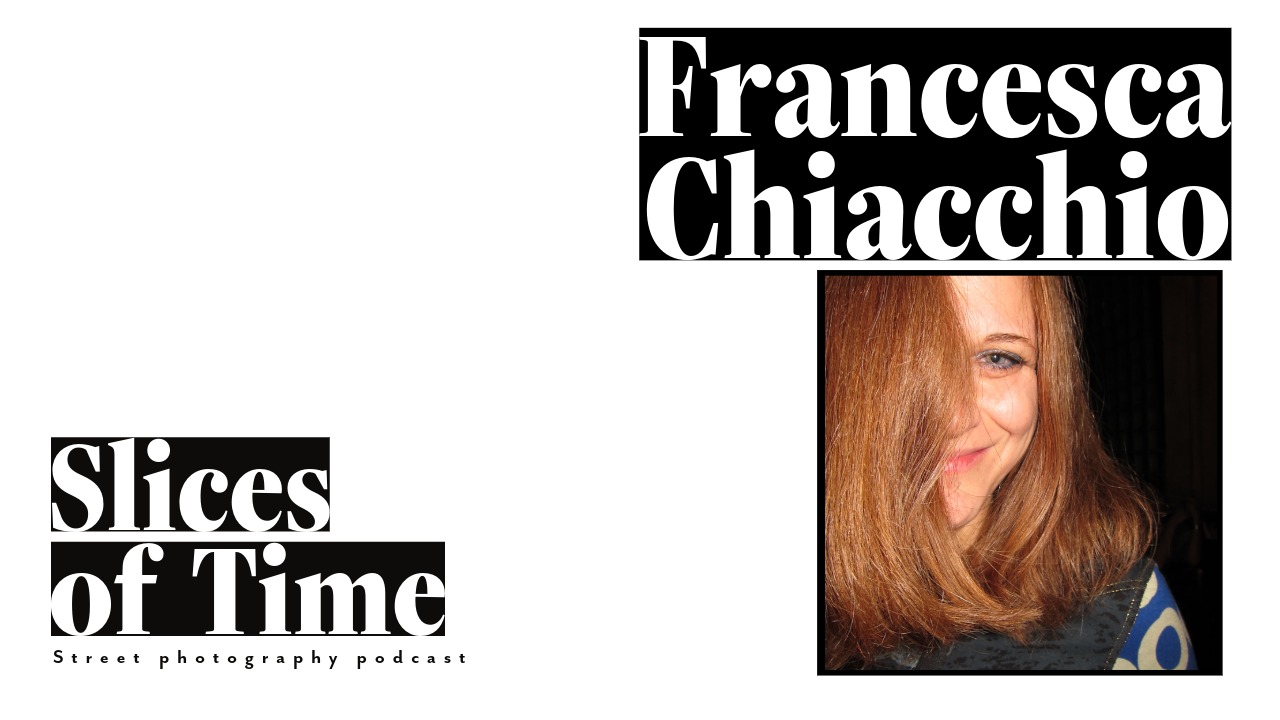
Today, I’m joined by Francesca Chiacchio, a street photographer from Napoli, Italy. Her work stood out to me because of how candid and intimate it feels.
Follow Francesca Chiacchio
- Website: https://www.francescachiacchio.com/
- Instagram: https://www.instagram.com/francescawho/?hl=en
Listen to the episodes on:
You can follow me on several social media for updates about the episodes:
- BlueSky: https://bsky.app/profile/fredpaulussen.bsky.social
- Instagram: https://www.instagram.com/fredpaulussen/
- My website: www.fredericpaulussen.be
Timestamps of this episode with Francesca Chiacchio
00:00 Introduction to Street Photography and Francesca Chiacchio
03:14 The Journey from Architecture to Street Photography
05:54 Workshops and Learning from Mentors
09:01 The Evolution of Style and Personal Growth
11:50 Teaching Street Photography and Its Therapeutic Nature
14:52 Capturing Events and Crowds in Street Photography
17:54 Cultural Influences on Photography
21:01 The Importance of Color in Photography
23:48 Future Aspirations and Travel Plans
30:35 Exploring Photographic Composition and Contrast
32:02 The Role of Flash in Photography
35:19 Capturing Authentic Moments in Street Photography
37:58 The Importance of Patience in Photography
44:33 Finding Inspiration in New Locations
49:43 Overcoming Shyness in Street Photography
Photographers, resources, and gear mentioned in this episode:
Thank you for listening to this conversation with Francesca. Don’t forget to subscribe to be updated about upcoming episodes. Feel free to reach out via social media if you have any questions or ideas you’d like to share.
Don’t miss any episode by subscribing to the podcast on Spotify!
Podcast Transcript
Frederic Paulussen (00:00)
So welcome to the slice of time street photography podcast episode 26, the first of 2026. So that’s nice. Today I’m joined by Francesca Chiacchio. So I’m going to try and pronounce it correctly every time. She’s a street photographer from Napoli in Italy. And her work stood out to me personally because of how candid it is and how intimate it feels at the same time. So, hey Francesca, maybe you could introduce yourself.
Francesca Chiacchio (00:30)
Hi everyone, I’m a street photographer from Naples. Even though I lived in US for many years, I started taking pictures at university during my architectural studies.
So I first use analogic camera and then in the last probably 10 years I’ve been using digital camera. And I approached street photography around probably 2016, let’s say.
Frederic Paulussen (00:59)
Okay.
Okay, was it at same time you started moving to digital? Was the move to digital because of street photography or was it just two things that happened at the same time? ⁓
Francesca Chiacchio (01:20)
Actually, ⁓ yeah, I mean it was easier probably to upload the pictures on Instagram because I got close to street photography because of Instagram. So yeah, that was much easier. And plus my… ⁓
my old camera, I mean, it got broken, so I really need a new camera anyway.
Frederic Paulussen (01:51)
Okay,
yeah, you needed the update and it just so happened and so that’s interesting to get to a street photography from Instagram I don’t think I’ve heard it before was it like you just happened to stumble upon street photography or was it because of maybe your architectural Background already or how did you how did you find street photography then?
Francesca Chiacchio (02:14)
sure about it. I think it was really true Instagram. I it’s hard because ⁓ when when you say street photography for me, it’s it’s not correct because street photography has always been there, has always been practicist practice by the most well known photographers, especially in America. ⁓
So I think now we say street photography, but there’s always been like this genre So I would say I ⁓ used to shoot on the streets, ⁓ but I didn’t put people in my pictures because I was more interested in graphic probably ⁓ other than buildings.
⁓ So, and people, so ⁓ I was trying to, yeah, to construct like textures, I would say textures. And then when I start looking at pictures on Instagram, I.
Frederic Paulussen (03:28)
Okay.
Francesca Chiacchio (03:37)
The first thing that really attracted me ⁓ was the light, the contrast between light and shadow. ⁓ So the first thing I did was trying to use the light a lot, always for graphic purpose, I would say. So I was doing a lot of silhouettes and colors,
of colors very bright colors I used to like and and that was it and then little by little I in 2000 I think 2018
I got my first workshop with Vineet Vohra in Rome at the Italian Street Photography Festival. And I remember Julia Coddington was there with me. So, and I already knew Julia as well through Instagram. So, you know, I was inspired a lot by these two people, Vineet and Julia.
And so after that has been really like a process because I follow Vineet for many years. I did several workshops with him and also with other photographers. But I have to say that Vineet is a very, very good teacher. so sometimes, you know, we think that a good photographer is also a good teacher. That’s not always true. And this is for everything.
I remember even in university, you know, there were like great architects and they didn’t know how to pass their knowledge to students. So I think it’s everywhere like that. So Vineet is a very good teacher other than being a great photographer. So that’s why I kept going with him and also because I saw, you know, every time I was improving, it was always challenging for me.
So
that’s how I progress. I ⁓ became what I am now and I do the kind of pictures I do right now.
was he taught me a lot about composition even though I was I was also you know an architect so for architectural ⁓ studies and projects I always had to to look for composition so for me was probably easier and my attention is still there because I really like to compose pictures
Other than going around and taking, I always say like, know, weird stuff or funny moments, I like to compose. So that’s one of my main characteristics.
Frederic Paulussen (06:49)
Yeah.
Cool, yeah, and because they’re photos, they’re very in the crowd. They do really look well composed, so was sure that you didn’t shoot from the hip, but you never just like, you always look to the viewfinder to make your photo, you never shoot from the hip, right? Or if I understand you correctly?
Francesca Chiacchio (07:12)
⁓
Okay, the beginning I was shooting from the hip.
Frederic Paulussen (07:16)
Okay.
Francesca Chiacchio (07:17)
because I was very shy. I was very, very shy. And still now, if I don’t feel comfortable, so if I’m like North Europe or, you know, cities where people look at you in a weird way, then I use the hip because it makes me feel more comfortable. But in general, I try to shoot from the viewer.
Frederic Paulussen (07:37)
Okay.
So it’s.
Yeah
and you find people in like southern europe like of course italy to be more open to be photographed in the streets then or okay
Francesca Chiacchio (07:52)
Yeah, I think so. think in
Italy in general it’s easier. But sometimes, you know, I would say, I don’t know, even in Paris or, know, depends, really depends on the cities.
Frederic Paulussen (07:58)
Okay.
Yeah, yeah, I was in London two or
three weeks ago and was there. It was very easy. Like no one cares. But here in Belgium, it’s different. Yeah, it’s people are definitely more aware of a
Francesca Chiacchio (08:19)
I was in Belgium,
was in Luxembourg, it’s not that easy in Sweden as well, you know, people look at you so in that cases I use the hip.
Frederic Paulussen (08:33)
Okay, that’s cool, yeah, that you still try to compose as much as possible. And so you mentioned you lived in New York, but you only started doing street photography when you came back to Italy or did you also do street photography?
Francesca Chiacchio (08:48)
Well, when I
was in New York, of course, I was shooting around. I still had my analogic camera. ⁓ But at the time, I didn’t include many people. So, yeah, I actually, would say start street photography as we mean it right now when I came back to Italy.
Frederic Paulussen (09:01)
Okay.
Okay because yeah New York of course is kind of like paradise for it so it’s to me it was funny to see that and so what triggered you then to start photographing people as you do now for example on your website?
Francesca Chiacchio (09:31)
Well, as I say before, for me it was more like something that, you know, related probably to the art world, graphics and stuff like that. But now for me it’s more like, I would say, introspective vision of the world.
I like to see what comes out actually from the pictures. I like to see ⁓ the glances of people.
And the way, you know, sometimes we don’t know the face we make when we walk around. We have no idea. I still look at myself sometimes in pictures. I don’t recognize myself. So the meaning is more like that. It’s like, ⁓ you know, like framing moments of lives that people don’t even realize they’re living in something like.
Frederic Paulussen (10:43)
Okay, yeah, that’s very nice and so
Well, talking about workshops, there’s a lot of questions there because you also give them, I understood, but maybe first because you said you followed several workshops with the same teacher or photographer, photographer teacher. So that made me curious now because did you notice you still had a lot to learn from that person or because for me, my strategy is usually to follow different workshops from different styles as well to see how I enjoy it. But you, of course, stayed within the same style with the same teacher.
Did you find that to be helpful for your growth in or?
Francesca Chiacchio (11:21)
As I said before, ⁓ tried different ones, but he’s the only one that really got me something, and I saw my improvements each time. ⁓ So that’s why I stick with the Vineet for a while. I don’t take workshops anymore. ⁓ I give workshops right now.
I also gave a workshop with Vineet a couple of years ago in 2024, here in Naples. But yeah, I think it’s very important and it’s up to you. mean, if you find your way.
with different photographers. The important thing is, I think is find your way of shooting, find your style. So whatever helps you to develop your own style, I think it’s useful. I am not just gonna say, you have to stick with one. I wouldn’t say that, but at the same time, I think until
you see that someone can give you something you’re better taking it that’s my idea so I that’s why I stick with Vineet because I knew that there was still something that they had to learn at one point of course for me was
I wouldn’t say I reach the point because I like to think they will never reach a point, a top point. ⁓
And I will never compare myself with the Vineet Vohra that’s for sure. But, you know, we are all different and we all have different views and styles. And I always thought that photography is a way of expressing ourselves. So.
you know, we never can be as different as another person. So that’s why I think, you know, each one of us has his own style. And that’s it. It’s very important because that’s what we should look for.
Frederic Paulussen (13:48)
Yeah.
Francesca Chiacchio (14:03)
That was
Frederic Paulussen (14:03)
Okay, yeah.
Francesca Chiacchio (14:04)
my main goal. mean, ⁓ of course, you don’t know when you reach the point, but, you know, ⁓ I see people looking at my pictures without knowing and they say, you know, that’s Francesca’s picture. So that’s good for me because I can see that people can recognize my pictures right now. It’s very important.
Frederic Paulussen (14:32)
Yeah, you have a very nice and distinct style. That’s also usually what I look for in guests on the podcast is like they have like a solid or like consistent style. So it’s not like, you know, for me, I’m still searching a bit. So I found the past year in 2025 that my style…
evolved also because of workshops that influenced me that I noticed like okay this is something that was there for me but I didn’t notice still. ⁓ So for you it’s clear that you have your vision, you have your style and that’s why I usually tend to photographers like you know those styles already because it’s usually also interesting because there’s a lot of searching ⁓ that happened already and a lot of work that has already been put in so I find it interesting.
something that I also noticed in your work is that you’re very attracted to like ⁓ festivities or ⁓ events. Is that something because you just find it like for example I do the same because it’s easier to blend in the crowd and be less noticed or
Francesca Chiacchio (15:40)
Yeah,
that’s for sure. I mean, I started like that because as I say, I was very shy. And I always suggest to do that to my students as well, especially at the beginning when you start photographing and you are intimidated by people. I suggest to go into crowds and events usually, people are not gonna say anything to you and most of the times,
especially if they are dressed up, they want to be photographed. So that’s the best way to learn also how to compose. Because of course, in order to learn how to compose, you need more layers and you need to…
to put them in the right place. So it’s good because, you know, especially in the crowds, people don’t move around. So you have the time, at least a few seconds probably, to compose. So I think it’s very good for learning.
Frederic Paulussen (16:50)
Yeah.
That’s an interesting take on it, ⁓ Having the extra time with the crowds. That’s not something that I would ever have thought of, but that’s totally right. And so for your teaching then, you don’t often have the luxury of an event happening probably. But so what I find interesting is for people who teach street photography is how you keep it…
Well, interesting to yourself because at some point it becomes like a job maybe or is it not something you’re too afraid of? If that question makes sense.
Francesca Chiacchio (17:31)
Actually, I don’t do it like full time like many people do. I do it like, let’s say, probably two or three times per year for weekends. So it doesn’t get me much time. ⁓ But the…
Frederic Paulussen (17:34)
Okay.
⁓ Okay.
Francesca Chiacchio (17:54)
You know, it’s fun. It’s fun. It’s my city. I like to show around my city. I like also to see people getting excited about street photography because a lot of people, come to my workshop, they just approach street photography. So they are not like high level photographers. ⁓
So it’s nice to see more people getting close to street photography. think I always say that for me, street photography was also a way to know myself better and to improve myself as a person because the fact that I was shy and I was afraid of approaching people
it was like in my real life as well. It wasn’t just about photography. So for me it was also a way to challenge myself to be a little bit different from the way I was because I don’t like being afraid of people and I had been afraid of people. So…
as I also say in another interview, I think street photography for me was also like therapeutic, very therapeutic. So, and I see a lot of people approaching street photography. They have similar problems. I will call it problems. Maybe they are not problems, but the
Frederic Paulussen (19:39)
Yeah.
Francesca Chiacchio (19:41)
the same fear, let’s ⁓ So I think it’s good for everyone to use street photography ⁓ to, you know, it’s a way to challenge yourself in life.
So that’s what I find very interesting. And I would say that I heard similar stories from different people and the way the, you know, street photography was useful for them. So I think it is very nice about it.
Frederic Paulussen (20:18)
Yeah,
it sounds like I’ve heard it before, but it sounds also very familiar because I have the same… I’m like, ⁓ what they call like ambivert, so I’m not really like an introvert, but I’m also an extrovert. Like I can handle people, but same time I’m shy and on my own, so to speak. So like in the streets to me, I prefer like one-on-one conversation. Being on the streets is very, well…
interacting on the streets is very daunting. So that’s very familiar and it’s definitely also like it’s a nice way to get to know your city because you start noticing things very differently I think like ⁓ how…
silly stuff like how roadworks work, you start to notice those things or like, there’s like a lot of color in that neighborhood and less in that neighborhood or it’s like all these different the light Yeah.
Francesca Chiacchio (21:11)
It’s where the light goes, which
time of the year it changes. It’s very, you you have to get track of all, lot of information. And then.
Frederic Paulussen (21:17)
Yeah.
Exactly, yeah.
Francesca Chiacchio (21:24)
And also what I like about photography is that it happens to me, especially in some countries. I I usually don’t talk to people before shooting them, but it happens that sometimes people want to talk with you after. So I like that. I like that part. And that’s also a way
of you know knowing people knowing cultures as well so that’s another interesting point about street photography.
Frederic Paulussen (22:10)
Yeah,
exactly. It’s a nice way to interact with the people from your city, of course, or from somewhere else and get to know different people. So you travel a lot, I found, or like you’ve been to several places in the 10 years that you’ve been doing street photography. Do you notice that, well, apart from, of course, know, like, for example, shooting from the hip in Sweden, is that ⁓ while you do
in Italy. Do you also notice that different cities or different ⁓ countries influence your style or how you look at things?
because of different architecture, different habits, different people.
Francesca Chiacchio (22:54)
Well, of course, think it must be this way. I think you can get influenced by the places you’re in. That’s not easy to tell that about Europe because…
So it’s to tell about Europe for sure if you are in different countries, ⁓ you know, like I went to Turkey or ⁓ I can imagine being in Africa or elsewhere. Of course, you are not going to shoot the same way. ⁓ I hope it’s going to be like that. I haven’t been in so many other countries other than Europe and
New York and Istanbul so I would love to I mean I have Every year I start thinking where I want to go this year and then of course, you know something happen or you have to to mix your Your personal life your work life It’s hard. It’s very hard the last year for me, you know, I had Family problems so I couldn’t travel much
So that’s why when I can’t travel much I usually stay in Italy or nearby. But yeah, my idea has been to go to Japan. ⁓ I want to go for the last two years and I haven’t been able to. I don’t know if I’ll be able this year, but you know, I have so many places I want to go, but you know, other than
Frederic Paulussen (24:33)
⁓ yeah.
Francesca Chiacchio (24:48)
And that I haven’t really, I mean other than India, I was in India in 2023, other than India I haven’t been in very different places I say.
Frederic Paulussen (25:04)
Yeah.
And so what attracts you to Japan, by the way? Like, I’m curious to what makes you want to go there. ⁓ Because it’s a very street photography ⁓ inspired place. it’s or like a very popular place. I can like I kind of know the answer, but yeah.
Francesca Chiacchio (25:23)
Actually, I have to say that since I was like 18, 19 years old, I had been attracted by the oriental culture. I used to read a lot of Japanese and Chinese writers.
I don’t know why, but to me, and I think for all of us in Europe, it seems so far away and so different culture. So I have always been attracted by different things. They are very different from myself, from me, from my culture.
Frederic Paulussen (26:07)
Okay.
Francesca Chiacchio (26:09)
So for me was something very, very different. And plus when I used to live in New York, I had several Japanese friends. ⁓ The first friends I got in New York were Japanese. I hang out with a bunch of Japanese people and I really loved the, you know, their kindness, I would say. Their food, because I love Japanese food. mean for me it’s the best.
Frederic Paulussen (26:38)
Same.
Francesca Chiacchio (26:38)
world.
Frederic Paulussen (26:40)
As an Italian, you dare to say that?
Francesca Chiacchio (26:44)
For me, I I love, I don’t eat, you know, I’m gluten free right now, so I don’t eat pasta, I only eat rice. For me, it be easier to live there actually. But yes, so it’s always been there, like in my mind, I want to go in both, like China and Japan, both of them.
Frederic Paulussen (26:52)
okay. Yeah, then Italian is very tough,
Yeah.
Yeah.
Francesca Chiacchio (27:13)
But yeah, I still have this friend, this Japanese friend. So I’ve been talk with her and I want to come, I want to come. And probably, you know, I hope sooner or later I’ll go. So.
Frederic Paulussen (27:28)
Yeah,
I hope so too then. Yeah, that would be very interesting to see your work ⁓ from there and your adventures. ⁓ And so… ⁓
One thing that I find maybe is, I’m not sure if that’s right, which I find less in the photos I’ve seen from Japan so far and that I see a lot in your work is it’s very, ⁓ well first of all, very organic but also very colorful. So is color to you like a very important aspect in your photography? Obviously it is because I don’t see any black and white but is there like a specific reason you prefer color over black and white or?
Francesca Chiacchio (28:10)
No, actually I started in black and white. I started in black and white with with the analogic camera. I actually like sepia colors. I don’t know if you remember the kind of it There was a time that everyone was printing in sepia. And then, and then I start using slides.
Frederic Paulussen (28:13)
really?
Yeah.
Francesca Chiacchio (28:40)
I don’t know, I think you call it slides. yeah, the frame, you had the little frame and the little pictures and you project them. ⁓ So that was my first colors I used. And those colors were very different from the one we have now because they were more.
Frederic Paulussen (28:44)
It’s called, yeah, yeah, slides. Yeah, correct. Yeah.
Okay.
They’re a bit
dull. No? Yeah.
Francesca Chiacchio (29:04)
They were more like in 70s style, probably. ⁓ So and then with digital, I approach really the colors. I like black and white pictures, ⁓ but I like colors better. And also because.
Frederic Paulussen (29:25)
Yeah, okay.
Francesca Chiacchio (29:29)
you know I always think you know we see in colors so why should we use black and white ⁓ even though I you know there are street photographers I really like the shoot only black and white
maybe one day I will do a project in black and white. I have no idea, but I like colors, I like ⁓ bright colors. A lot of people tell me, you know, your photography is about colors. It’s not really like a conscious choice. It’s more like what I like because I, you know…
Frederic Paulussen (29:48)
Yeah.
Yeah.
Francesca Chiacchio (30:13)
Sometimes I see also in the way I dress up, I use the black colors. So it’s just the way I am.
Frederic Paulussen (30:20)
Yeah, no,
make sense. it’s, ⁓ to me it’s interesting because you also look at like black and white photographers you say, is it more like for composition then or yeah, probably. Or do you look at, or yeah, or now even like, you, yeah.
Francesca Chiacchio (30:33)
you mean photographers in black and white?
about composition, it’s more about contrasts. That’s for sure because I like very, I like the contrast between very dark parts of images and very bright. So ⁓ that kind of black and white, not like all grayish tones, but ⁓ very contrast black and white.
Frederic Paulussen (30:45)
Okay, makes sense.
Yeah.
Yeah, I know what you mean.
Yeah.
Yeah, that’s what I prefer as well, I think.
Francesca Chiacchio (31:10)
Like
Japanese sea photographers.
Frederic Paulussen (31:14)
Yeah, kind of like his
Chinese but Fan Ho is very, very contrasty. ⁓ And so do you take a lot of inspiration from photographers and photos still or is it more something you don’t really make time for that’s just something that sometimes happens or? ⁓
Francesca Chiacchio (31:37)
I think we are influenced by whatever we look at. So it’s not like I look at the book and I say, oh, I want to do like that. No, it’s more I think something in your mind. You get information. You will probably save it somewhere in your mind. And then when you take pictures, probably you have been influenced by that, but you don’t even know. It’s not a conscious. Yeah, yeah.
Frederic Paulussen (31:41)
Yeah, but you don’t actively…
Okay.
Yeah, it’s more a subconscious influence. Yeah. Yeah.
Okay. That’s cool. And so I noticed that you also use flash in your photos. That’s and especially since you mentioned you’re a shy person to me that that’s kind of like very signaling. Like, hey, I’m here and I just took your picture. Is that something that is because you were shy that you started using it or is more like a stylistic choice or?
Francesca Chiacchio (32:31)
No, I think it’s more a stylistic choice. ⁓ I like the effect on the pictures. can see the limits of the borders of the subjects more defined, probably.
Frederic Paulussen (32:57)
Yeah.
Okay.
Francesca Chiacchio (32:58)
more
precise that’s what I like about it and and of course the the colors as well they become brighter so yeah it’s totally think it’s delictive.
Frederic Paulussen (33:12)
Okay,
and so was it was it at first and a tough decision or like hard to start using the flash because because of the shyness or did you kind of like went easy with or like was it easy for you?
Francesca Chiacchio (33:29)
I don’t think there is much difference because I think people, if they get upset, they get upset anyway, even without flash. don’t think that. other than that, think, especially in events, it doesn’t really matter. ⁓ And if you shoot with bright light, with sunny weather, the flash doesn’t really ⁓
Frederic Paulussen (33:47)
care.
Francesca Chiacchio (33:59)
Yeah, people don’t know this much. So that’s my idea. So I don’t think there is much difference between using or not using flash. Of course, I wouldn’t use probably flash in Copenhagen, but I would say in a northern city, it’s hard. ⁓
Frederic Paulussen (34:02)
People don’t notice, yeah. Yeah.
Okay.
Francesca Chiacchio (34:27)
If I can take pictures, I can use flash. That’s my idea.
Frederic Paulussen (34:31)
Okay,
yeah, that’s cool because to me it’s also in a subtle way, like I notice it because I know the light, but it’s also, you have like photographers where it’s very clear it’s flashed because it’s at night and the flash does a lot of stylistic… ⁓
carrying the style. But for you it’s kind of like a subtle kiss of light to, as you say, pop out the colors better or make the subject stand out more. ⁓ So that’s definitely interesting. And also you don’t mind having people look at the camera. That’s ⁓ something you don’t often see in street photography, I think. So do you sometimes pose people as well or?
Francesca Chiacchio (35:19)
And if I talk to people…
Frederic Paulussen (35:21)
Yeah, if you say like you do stand like this, because there’s like a lady with like two dogs for example.
Francesca Chiacchio (35:25)
No,
no, never, never. I don’t like doing that, no.
Frederic Paulussen (35:29)
Never.
Francesca Chiacchio (35:31)
I don’t like posing. The thing is when people ⁓ notice that you are taking pictures, they start posing. So what they always suggest is, you know, to wait a little bit because after a while they’re going to get tired of posing and so you can get the best picture that time. So usually, as everyone says, either is the first picture or the last
Frederic Paulussen (35:39)
Hmm.
Okay.
Francesca Chiacchio (36:01)
one that are going to be the best ones. But yes, what I do, I usually wait a little bit until they relax and they start posing and maybe they get distracted. But most of the times it’s the first picture when they didn’t realize. But no, I don’t tell people do this and do that, you know, unless, you know, sometimes I see them in a certain way and
And they say, keep it. Like it can happen. For example, I remember, I don’t know, the Pride. There was this guy with the fan in his hand doing this. And so he was going down with the fan. was like, no, keep it. It’s just one second or something.
Frederic Paulussen (36:52)
Yeah, yeah, yeah, okay.
Okay, that’s, yeah, makes sense. And…
Francesca Chiacchio (37:02)
So it’s something that I have already seen it. So I’ve seen a picture and then maybe the person is moving and I’m like, ⁓ no, don’t move. Something like that.
Frederic Paulussen (37:05)
Yeah
Yeah,
yeah, I can imagine that happening. It’s also often because you start taking photos and people start posing and it’s like, no, no, it just, I’m not here. Yeah. That’s something I like. I’m an event photographer, so a corporate event photographer. And I very often say like, I’m not here. Like people start posing as you say, it’s like, no, no, I’m not. Just continue talking, continue having your drink, continue whatever you’re doing. ⁓ So that’s, yeah. And so.
Francesca Chiacchio (37:35)
Yeah, yeah, right. Right.
Frederic Paulussen (37:43)
You’re patient person and if you say that you sometimes wait for them to get tired of ⁓ posing or does it happen within three seconds for you?
Francesca Chiacchio (37:58)
I’m not patient. I’m not. I’m totally not. But with the street photography, think you need to learn how to be patient. That’s another thing. Because it happens a lot even that you probably find a background that you like, something that you like, and you have to wait a little bit ⁓ until something happens. So.
Frederic Paulussen (38:00)
Okay.
Francesca Chiacchio (38:29)
I a question again.
Frederic Paulussen (38:31)
Yeah, if
you’re patient because as you said, like if you sometimes wait for people to stop,
Francesca Chiacchio (38:34)
Yeah,
mean again, yeah, you have to be. have to be. ⁓ I’m patient just because I want to get the right picture. That’s what makes me patient. Other than that, I’m not patient at all. So in real life.
Frederic Paulussen (38:44)
Yeah.
Okay, it’s something I’m learning the
past ⁓ half year, let’s say. There’s been a few experiences that every time it teaches me to be more patient, so I totally get it, but it’s hard sometimes. I’ll stick around for 20 seconds person that’s… A month ago I did a workshop and we had to do an assignment and it was like…
pick a spot, stand there for two minutes without taking any photos. So just like two minutes of observation and then you’re allowed to ⁓ take photos for like 10 minutes that you have to stay in it’s like two by two meters spot. And it was so tough for me to be there like for two minutes just looking around it was, but yeah, it taught me that it is useful because a lot of things can happen in those two minutes.
and lot of information comes to you in the two minutes, but it’s so, so I’m not sure like, is two minutes tough for you or? ⁓
Francesca Chiacchio (39:52)
⁓ I don’t know, I never done this kind of tricky ⁓ games, I will call them. But again, think you have to be patient in photography. ⁓
Frederic Paulussen (39:59)
Yeah.
Yeah, but you can wait
around for like a few minutes if you see a place.
Francesca Chiacchio (40:14)
even hours.
Frederic Paulussen (40:16)
hours.
Francesca Chiacchio (40:20)
You know, for me, while I take pictures, I get in a trance status. So I don’t realize how long ⁓ I’m going to be in that spot with that person or with that scene. I can be forever. I can be an hour. can be three hours. I can be all day long. You know, sometimes I have to say myself, okay, stop it. Because I will go on and
Frederic Paulussen (40:28)
Mm.
Francesca Chiacchio (40:50)
because if I like a scene, then, and you know, for example, I will make an example. ⁓ The last time, the last summer, I was in Amsterdam, okay, and there is this square where I got actually a very good picture with pigeons.
Frederic Paulussen (41:10)
I know the
square, ⁓
Francesca Chiacchio (41:13)
Yeah. And
you know, people were coming and going. So the scene was there because the pigeons were there, but the people were always going in and out. So they were always different people. So always something different was going on.
So for me it was, I really could stay there forever because you can get many pictures. And then of course you’re gonna get, you know, 10 good pictures of pigeons, which I don’t know if you want it, but at least I can choose between the 10 pictures and get at least one good one.
Frederic Paulussen (41:57)
Yeah, that’s funny. it’s one of my because I’m ⁓ It’s not yet a project but I’m really interested in the pigeons on the street because to me it’s it’s like it’s a funny subject So yeah, if I’m in Amsterdam, which I’m gonna try to do at the end of this month as well is I usually go to that square because there’s always so many pigeons so many tourists and there’s this one guy Who yet?
Francesca Chiacchio (42:18)
Yeah, and sorry, the guy that
hit them, yeah.
Frederic Paulussen (42:23)
yeah but i’m not sure
does he because he doesn’t ask money for it so i’m i think so he does okay because it’s it’s
Francesca Chiacchio (42:28)
think he does. I he does. I’ve seen people giving
him money. I think he does for money. I don’t think he loves pigeons more than anyone else. I mean, that’s my opinion.
Frederic Paulussen (42:35)
Okay, yeah.
Okay, yeah, was wondering because it’s like it was because Yeah, I’ll have to
yeah, I’m usually there for like 10 minutes and then do a like a walk around and I come back and then for 10 minutes So it’s I’m not a but maybe I should stay for
Francesca Chiacchio (42:52)
There are a lot of squares
like that even you know in Venice Milan in front of the Duomo so there are a lot of
Frederic Paulussen (42:56)
Yeah, well, but that’s why… ⁓
That’s why I find it such an interesting
⁓ subject because everyone hates pigeons. It’s like in Belgium we call them the rats of the sky. It’s like a diseased ugly animal. But at same time, if you go to like, for example, Venice is a very good example. It’s like there’s so many stalls that sell seeds to feed the pigeons. So it’s all of a sudden it becomes like a touristy thing. And we all love it for like photos. to me it’s, I don’t understand the…
Francesca Chiacchio (43:12)
We yeah, we call it.
Mm.
Frederic Paulussen (43:31)
⁓ the two ways we look at the same animal. ⁓ So yeah, that’s why I like the pigeons.
Francesca Chiacchio (43:36)
Yeah. ⁓
And they’re very,
you know, how do you call it? They come out very well in pictures.
Frederic Paulussen (43:47)
Yeah, photogenic, yeah, true. Yeah, that’s true. And it’s also
like, for example, here in Antwerp, there is like a beer brand and the pigeon is their logo, but it’s like, it’s a dirty animal. it’s why, but yeah, but at same time, it’s a very photogenic, yeah, animal. So that’s why I find it funny. So I had a question that I thought about earlier, but now I forgot. I have to see if I can think of it again.
yeah, it’s ⁓ what makes you, what gets you outside to take photos. What motivates you to take a camera and go out ⁓ today or tomorrow or whenever.
Francesca Chiacchio (44:33)
I don’t go out much. I am ashamed of that. But I don’t go out much by myself, especially in Naples. ⁓ What makes me taking pictures is something new. So that’s why, you know, I would say I’m not attracted by my city, but it’s not like I’m not, ⁓ I don’t have.
Frederic Paulussen (44:35)
Okay.
Okay.
Francesca Chiacchio (45:02)
the need I don’t have the urgency of going out and taking pictures because for me these are the streets where I walk around everyday. So what makes me very willing to take pictures is traveling. So that’s why I try to travel as much as I can in order to take pictures.
Frederic Paulussen (45:07)
Mm-hmm.
Francesca Chiacchio (45:27)
And at the same time, you know, if I’m in good company, I like going around with cameras. So either way.
Frederic Paulussen (45:35)
Okay, so
you like doing street photography with someone then?
Francesca Chiacchio (45:40)
I like that, yes. I don’t mind that. I like going around with other photographers.
Frederic Paulussen (45:45)
Okay.
It’s funny, usually people are
like, no, I don’t do it solo and if I’m with people, we just talk and it’s fun, but it’s…
Francesca Chiacchio (45:51)
It’s, no, it’s
different. I think it’s different. But I got a very good picture here in Naples with other people. It’s not about that. Of course, the risk is that you can get similar pictures with another person if you’re together. That’s the big risk. ⁓
you know but if you are both okay with it then it’s fine. I don’t like when people start getting like oh this was mine or you I mean I’m not gonna copy your pictures but if we are in the same place in the same time of course we’re gonna get similar pictures even though I think they’re never gonna be the same.
Frederic Paulussen (46:20)
Yeah.
It might happen, yeah.
To me it’s interesting sometimes because I see it differently because like for example the workshop I did three weeks ago with the two minutes waiting around. ⁓ It’s like with five people we all know each other very well. We’re all street photographers from Antwerp.
But even then, like we were together most of the times, everyone saw things that I didn’t see and vice versa. at the end of it, it was like every 15 minutes there was a new assignment. at the end of it, I looked at other people’s photos and I was like, I had never seen that. Even in my own city, I’ve never seen this before. So I think that’s also interesting though. But yeah, it’s…
definitely how you look at it and if you’re okay with having similar photos sometimes, yeah.
So yeah, and then you prefer to go outside of Naples for photos then if I understand correctly. It’s more inspiring to find new locations. okay. Makes sense, yeah. And I’m curious, how did you find Amsterdam for photographing?
Francesca Chiacchio (47:40)
Yes. Yes.
Frederic Paulussen (47:56)
Because to me it’s kind of like, people are… it’s definitely like a northern city, but people aren’t too shy in the Netherlands, I find.
Francesca Chiacchio (48:02)
Yeah.
⁓ well it wasn’t that easy especially with flash I was there when there was a celebration the was the the sail parade
Frederic Paulussen (48:24)
It’s like Kings Day, it’s like every…
yeah, yeah, it’s like with all the huge sailboats and smaller sailboats as well.
Francesca Chiacchio (48:35)
Yeah. So
so it was a little bit easier because there were a lot of people around. But still, you know, some people didn’t like it. ⁓ I don’t like shooting like that. I really don’t like because I feel uncomfortable. ⁓
don’t like when people get upset. So that’s why I always look for events and places where I can feel more comfortable because I don’t, you know, for me, you know, getting pictures is, must be relaxing in a relaxing environment. I cannot get stressed because otherwise I’m not gonna get good pictures. So that’s why I look for…
Frederic Paulussen (49:14)
Yeah.
Yeah, I think that’s really good that you know that for yourself. Like, I don’t like this happening, so I’m gonna find ways to have it not happen or happen less, at least. So I think that’s actually a… Like, I’m sure there’s people who love the rush of having someone tell them no, but yeah, it’s… Everyone’s different. Yeah.
Francesca Chiacchio (49:43)
No, not at all. I hate it. You know,
I end up, in these cases, I end up ⁓ taking pictures of reflections. That’s what I end up.
Frederic Paulussen (50:02)
It’s
less in the face, that’s true. But yeah, to me it’s funny that after this conversation that you’re shy and non… How do you say? Like you don’t like the conflict. But in all your photos I see so much, like you’re so up close and you’re so connected with your subject. So it’s funny to find that… ⁓
Francesca Chiacchio (50:28)
No,
of course, you know, with the years I became ⁓ less shy and less fearful. ⁓ Like before when people were aggressive ⁓ towards me, I was getting so upset and so sad and maybe I didn’t take pictures for an hour or something like that because it happens all the times that people get aggressive.
Now it’s different. Now I don’t feel that bad anymore. I also try to talk to people when they get like that, even though sometimes they don’t want to hear anything. ⁓ But I’m conscious that it’s going to happen. So I know it’s going to happen.
Frederic Paulussen (50:59)
you have that off and you’re okay.
That’s also a very good way to grow, yeah. And to have to use street photography as a way to be less sad about bad things happening. Yeah, or like getting a no isn’t too bad. No, no, no, no. Yeah, but yeah, but.
Francesca Chiacchio (51:46)
I’m not saying I’m a rude person and I’m not gonna get affected by it, but I would
say it doesn’t affect my sensitivity that much more because I’m aware that it’s gonna happen. It can happen. So…
Frederic Paulussen (51:58)
Yeah.
Yeah.
Yeah, and you
know how to deal with it now. Yeah. That’s cool. So I think maybe we should start wrapping it up there.
So thank you Francesca for your time and insights, it was very very interesting to me. ⁓ So if anyone wants to follow Francesca, obviously her link to her website and to her Instagram will be in the description. ⁓ So make sure to follow her because her photos are very ⁓ colorful, intimate and amazing. Also make sure to follow the podcast of course on your favorite platform, which is probably the platform you’re listening on right now. And feel free to share this episode with a friend who would be interested. So thank you Francesca.
Francesca Chiacchio (52:17)
Thank you.
Thank you, Frederic
Thank you.
2 thoughts on “Slices of Time Episode 026 Francesca Chiacchio”