
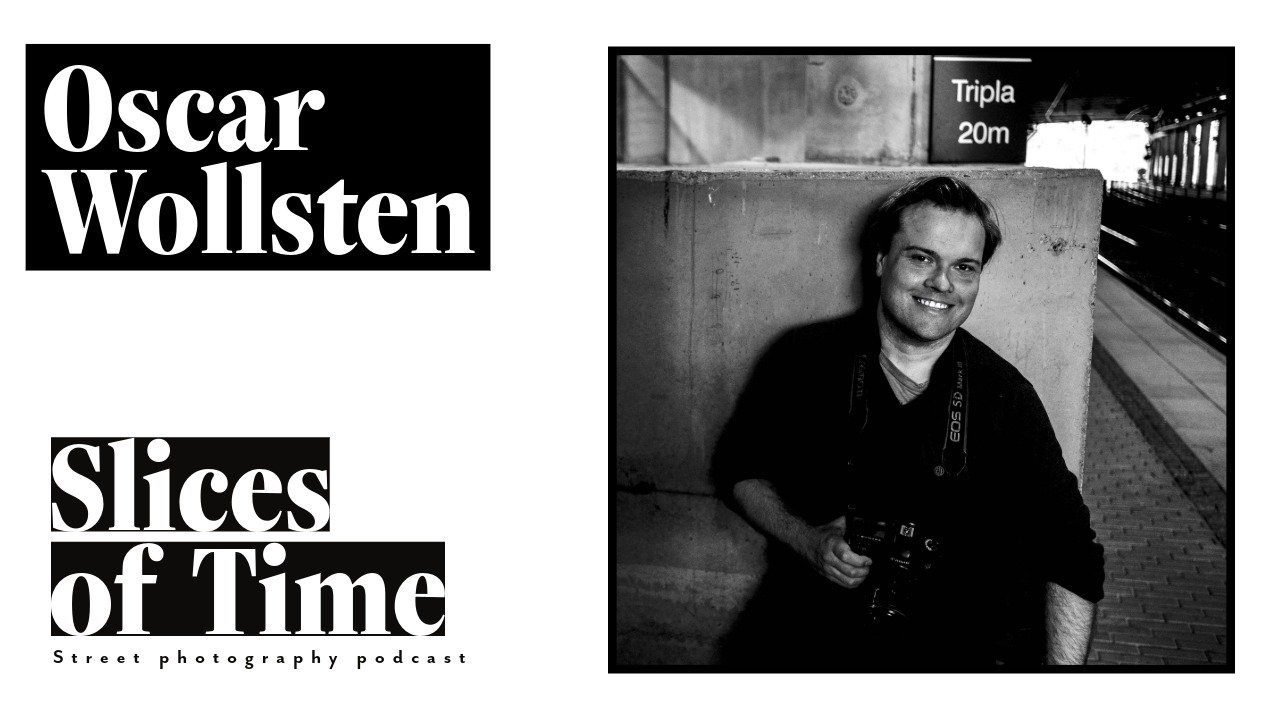
Today, I’m joined by Oscar Wollsten, a street photographer from Helsinki. His work speaks to me because of his emotional black-and-white double exposures.
Follow Oscar Wollsten:
- Website: https://www.oscarwollsten.com/
- Instagram: https://www.instagram.com/oscarwollsten
Listen to the episodes on:
You can follow me on several social media for updates about the episodes:
- BlueSky: https://bsky.app/profile/fredpaulussen.bsky.social
- Instagram: https://www.instagram.com/fredpaulussen/
- My website: www.fredericpaulussen.be
Timestamps for this episode with Oscar Wollsten
00:00 Introduction to Oscar Wollsten and his street photography style
04:00 Experimental workshops: multiple exposures and in-camera techniques
07:53 Pre-visualization and spontaneity in multiple exposures
11:57 Combining photos from different days and ongoing projects
15:54 Influences from film noir, film directing, and visual arts
20:02 The importance of storytelling and expressive shapes
21:14 The Helsinki project: social issues and social worker collaborations
27:56 The influence of the COVID-19 pandemic on projects
31:59 The role of influence from photo books, films, and literature
36:08 Photographing in Helsinki: areas, safety, and social considerations
37:54 Dealing with street photography ethics and interactions
39:56 Creating visual stories that respect subjects and context
41:54 The monochromatic aesthetic and its emotional impact
43:55 The role of gear, limitations, and minimalist setups
45:50 Innovative ideas: from mouth to textures and everyday objects
47:55 Serendipity and spontaneity in creative projects
49:58 The influence of film, novels, and visual arts on style
51:53 Balancing inspiration, experimentation, and technical skills
53:56 The importance of personal vision and ongoing development
55:52 Final thoughts and advice for street photographers
Photographers, resources, and gear mentioned in this episode:
- Canon 5D Mark III
- His photo series Encounters
- Cartier Bresson
- Alex Webb
- Trent Park
- Ray Metzker
- Hitchcock
- Tinkers by Paul Harding
- Oscar’s Teeth Double Exposure
Podcast Transcript
Frederic Paulussen Welcome to the Slice of Time Street Photography Podcast, a podcast in which I explore the work of different street photographers across the world, genres and visions, because it’s a very broad genre. This exposes you and me to different ideas and ways of looking, helping you form your own visions of street photography, which I think is very useful in finding your own style and vision. Today I’m joined by Oscar Wollsten, a street photographer from Helsinki.
His work spoke to me a lot because he has this very emotional black and white style and uses double exposures, which I find a very interesting technique. Hey Oscar, how are you? Could you introduce yourself for a second?
Oscar Wollsten Hi Fred, thanks for having me. I’m Oscar and I’m from Helsinki, Finland. I specialize in street photography and especially this more experimental approach to street, as you said. I’m very often looking for something that’s a little bit more surreal, something where the image itself creates its own world. I use in-camera techniques to try to achieve these impressions, which means lots of intentional camera movements, multiple exposures, and so on. I run workshops in Helsinki. I’ve been doing one-on-one workshops and groups in different places for four years now. I shoot portraits and some commission work here and there for different magazines, but mostly I shoot black and white street photography.
Frederic Paulussen That’s already sparked two questions for me, which I always find so fun. A few words can spark so many questions. The first one is about the workshops. Are they mostly directed to your style, do you give a more general beginner explanation, or is it really teaching how to do street photography like you do?
Oscar Wollsten I have different courses. With the one-on-one sessions, I always ask what the participant needs. Very often they want to learn my style, so then we focus more on the creative techniques and that specific approach. But sometimes it’s people who have just started street photography and are interested in a broader approach. In those cases, I just show a little bit of my way of doing it and mostly keep it simple and accessible to begin with.
For the group workshops, I have very different kinds of things. I have a basic course where we look at the key masters who have done it before and their approach. I try to present a very wide range to feed them with lots of influences so that maybe they will pick up on a style that inspires them and go towards that.
The advanced courses are focused more on specific themes, techniques, and approaches like rhythm. The goal is for each participant to gradually move towards their own approach. I try to give them assignments, exercises, and feedback to help them get to a point where they feel they’re actually expressing themselves rather than just imitating.
I also have experimental workshops where I show a lot more of the multiple exposure work and how to handle it. Those are fun because you’re improvising and building a puzzle in front of ten people. You might do nine layers of a shot; sometimes it works pretty well and sometimes you have to keep experimenting to pull off something that works. Those are good challenges for myself. I enjoy a little bit of that pressure where you have to be on the spot and quickly show how you would build an image in that moment.
Frederic Paulussen I always find people who give street photography workshops so brave, because if nothing happens in the street, how do you do your workshop? It’s really cool that you have all these different approaches. Because you have a very specific style, I was curious if it was easy for you to break out of it. Sometimes your style is just how you are and how you work, making it hard to just do general street photography and educate people on it. You mentioned that you always do your double exposures in camera. Do you ever combine them afterwards?
Oscar Wollsten No, I’m so poor at Photoshop and all those things, so I always try to do everything in camera. That’s where it started. I should probably be a bit better at post-production since I’ve been shooting for over seven years, but it naturally developed this way. It wasn’t originally some grand scheme; a lot of it has to do with limitations. I’ve had one camera and one lens this whole time. With the Canon 5D Mark III, you can do multiple exposures, so it was just a way to utilize the most out of the camera.
I started to find it a lot more rewarding to do it in camera rather than in post because it’s exciting when you see it happening in front of your eyes. You find these quite strange coincidences in how those layers start to blend and match. I think I would have a lot more difficult time doing the same thing in post because I wouldn’t know how long to sit by the computer to find things that match perfectly.
Frederic Paulussen That’s what I was wondering in advance, how much time you would need to combine those photos. For some photos, you can see it’s the same scene photographed multiple times, so it makes sense to do it in camera. But for others, it seems like two or three totally different situations. For multiple exposures in the camera, you have to do it chronologically, which requires quite a lot of vision in advance. Do you really think your photos out before you take them?
Oscar Wollsten The chronological part is made a little bit easier with the 5D Mark III because you can actually pick an earlier layer that you have shot. You don’t have to do it linearly straightaway. I think newer models have the chance to see a live layer on top of your view. I don’t have that, so I have to remember all the layers. If I start to compose small figures in the corners of the image, I have to remember how I composed the previous shot.
It’s an interesting blend. Sometimes I get a vision beforehand for multiple exposures and think about how I could pull it off, what I would need, and where I should go to create it. You start to work with it, and sometimes it works, but very often it doesn’t. But then sometimes it comes out even better than what you envisioned first because life creeps in. You get these coincidences and happy accidents that you start to utilize, and it becomes a lot more interesting than what you pre-visualized.
Other times, you go around the street and see a really fascinating texture. I remember quite clearly there was a trash can filled with rust and eroding paint. I thought it was great texture and shot a couple of different versions of it. It took me quite a long time to figure out what to do with it. With that texture, I noticed you have to overexpose some of the layers you do on top of it, which is not how I usually shoot—I usually underexpose a lot. Once you figure it out, it becomes intriguing. You’re creating shots you haven’t done before, get excited, and shoot a small series out of it.
The same thing happens if you see pollen-stained water in a pool. It looks like an oil painting, and you start to experiment on how to add people. Should it be silhouettes? Can I put street portraits here? You see where it takes you. I like to go back to the same theme sometimes. If I see that an idea works, I might try it again but add faces in. It totally depends on whether it’s going to work or not.
Frederic Paulussen It seems like it requires lots of tries, so there are probably a lot of missed opportunities as well. Do you sometimes keep older photos on the card to combine later, or is your process more closed off in time, like combining photos taken within a day or two?
Oscar Wollsten It’s exactly like that sometimes. Often I just combine them on the fly on the same day. If you get an idea that works, you follow that, and maybe you go back another day to continue that series. Even now, I have one set I haven’t published because I’m still trying to crack how to make it work. It’s an idea of a starry night sky, and I’m trying to combine it with different shots. I shot one layer back in the winter, and now we’re in August, and I still only have two or three shots that sort of work.
I want more. I feel there’s something missing that I haven’t cracked, and it’s bothering me. I keep that layer in my camera saved and protected, and sometimes when I get an idea, I try to make it work. It has a round, sphere-like shape, which makes it a tricky form to fill. I wouldn’t like it to just be silhouettes. Silhouettes work well, but I want a bit more variety to make a proper series out of it.
You struggle with stuff like this. Then sometimes it comes together instantly, like that pollen-stained water. I did that in one day, in just a few minutes. I shot the layer, realized there was a spot around the corner where I could clearly use good shapes and forms of people, and shot the whole series in one day.
It keeps you on your toes and keeps you looking in the street. Everyone has phases where they feel they’re repeating themselves or don’t know what to do next. Working on an old series is a way to get back into the vibe of shooting. While you’re trying to make an old idea work, maybe another scene comes along and you get a better shot.
Frederic Paulussen So the experimenting seems like most of the fun of hitting the streets for you. For some people, like me, the fun is going outside, seeing events, and watching the city evolve, but for you, it’s more about the experimentation.
Oscar Wollsten I think so. It has gone that way. It carries the idea better because you’re working on stuff that, if you can pull it off, makes something special for yourself and feels personal. I think it’s partly because my mind just works this way. From the start of street photography for me, it was always connected to trying to express yourself. Not that you necessarily have the tools in the beginning, but it was more about that than just documenting street life.
I’ve done a documentary project, and I found it very rewarding, but it’s a totally different thing. You’re trying to build a cohesive narrative out of a long project spanning six months or more with a lot of material.
Helsinki is not a huge city. I actually started shooting in Riga, Latvia, for the first two or three years, which is even smaller. When I moved back to Finland, I continued. None of these are very big cities, which limits you up to a certain point. You get tired of walking the same streets and feel you are repeating yourself. Repeating yourself happens with creative techniques too. Even if you’re trying to figure out a cosmic starry sky, you still feel your own limitations. It’s not always exciting; sometimes it’s grinding, problem-solving, and figuring things out.
It’s a personal answer for me to use this approach, but I can see how for someone else this would have the opposite effect. They get more inspired by what the streets can give them, the life that happens, the small coincidences, and how the light shines on a street corner or a person’s face.
Everything in street photography is difficult to do well. There’s a lot of talk nowadays that silhouettes are an easy thing to do, and that you should always have random faces in your picture. But having five faces versus five silhouettes doesn’t automatically make it better. Whatever you’re doing, it should tell something and resonate with you as a photographer. Simplifying everything into strict compositions just to make an authentic street work doesn’t mean you’re actually telling a story. If you’re doing silhouettes, you should try to do it well. Small things like body posture, how it’s drawn out, the light, and the background all count. You’re looking at a shape versus a face, but both should have something expressive that leans towards a narrative or atmosphere.
Frederic Paulussen I totally agree. You talked about your series which is more documentary, called Encounters. I’m not going to try to pronounce the Finnish name. You followed street-based social workers in Helsinki to help people out with homelessness and addiction. It’s more documentary, candid, and not posed. You didn’t do double exposures or longer exposures there, but you still managed to make it feel like your other photos. Was there a certain way you achieved that? Also, was it a collaboration with the city of Helsinki or your own project?
Oscar Wollsten It was a collaboration with the social workers, but the idea came from my side. When my father was five years old, he was playing on the ice in Finland, dropped through, and thought he was going to drown. He felt his hand picked up by the neck; it was a homeless guy drinking by the seashore who pulled him out and saved his life. That story stayed with me since I was a kid.
When I was trying to figure out a longer project and read about these street-based social workers in a newspaper, I thought it would be something where I could tell a story bigger than myself. I wanted to focus on a theme that could be beneficial for everyone. It was great for the social workers because they got more exposure out of it, and we managed to get a two-and-a-half-month exhibition out of it. It was also great for the subjects, many of whom were homeless people or individuals with memory-related illnesses. They got to see themselves in a different light.
There were lots of heavy, hard stories and desperation around it, but our goal was to visually present them in a respectful, dignified light rather than showing them passed out on a street corner. Visually, I pre-visualized a gallery wall straight away when I got the idea. I could picture the main big pictures and a collage of smaller scenes. And it just ended up happening. It’s interesting how these things come together so well. You start to build that wall in your mind and I just leaned into that.
The only thing I tried to do was stay out of people’s way, work on each scene, be present, and understand what the scene needed to be told in the best way. Sometimes it was a very intense portrait, sometimes it was a wide shot showing everyone around, and sometimes it was just a detail. That project made me feel like I stepped up a bit. Before that, I felt I was doing this more as a hobby. It was a difficult project—shooting eight hours a day, five days a week for six months. You have an enormous amount of material, you have to tell the story, and pull the project together for an exhibition. I got lucky that we found a very good publisher in Finland ready to publish a photo book out of it. We never got funding though, so it’s still pending. I still want to make it, but the market here is so small that you can’t independently finance it.
Frederic Paulussen I can imagine. That’s cool because I didn’t know it was a six-month, full-time project. That’s really intense. Was it often with the same people?
Oscar Wollsten The social workers spread over the whole area of Helsinki—north, west, south, and east—and they worked in pairs. I would go Monday and Tuesday with the north pair, the next two days with the east pair, the last day with the west pair, and start in the south the next week. I saw the whole array of their work in every direction.
It was quite emotionally tasking. After I had been shooting for five months, they asked if I had someone I could talk to, because they have therapists from work and I didn’t have anyone. There were moments when I would come back from shooting and just stare at the wall silently for two or three hours because of the things you end up seeing.
I made one mistake that I regret. I shot eight hours a day, then I would come home and edit the pictures I had shot that day. That’s eleven or twelve hours of work every day, and it’s too much. If I did it again, I would leave the editing for another time period because you’re living the same stories over and over again. You’re exhausting yourself listening to the same heavy things. It is very emotionally tasking.
Frederic Paulussen I can only imagine. It’s good that you mentioned that for people thinking about doing these kinds of projects. How long ago was this?
Oscar Wollsten That was 2021. It was exactly when COVID was all over, so everything was in lockdown at the same time. It added a unique element to it and made some shots possible that wouldn’t be today. I remember days in the Helsinki Central Railway Station, which is usually filled with passengers and tourists, and there would be basically no one there except the social workers and their clients. I got quite a few shots of empty halls where encounters were happening between the social workers and someone in need of help. It had a very eerie atmosphere.
I have been thinking about doing a second round with this project, but I think I will wait a bit longer. That was five years ago, so maybe I’ll wait five more years and go back to the streets to see if anything has changed. If nothing has changed, that’s dramatic and powerful. If something has changed, that can also be dramatic and powerful.
Frederic Paulussen Both outcomes are interesting and have a story. Because a lot of it was on the streets, does that influence your work now? Do you still encounter those people, and do you look at how the city works differently now?
Oscar Wollsten Definitely all of the above. Sometimes I see the guys who were in the project. Unfortunately, a lot of them have passed away. I heard two passed during the exhibition. It’s quite dramatic. You feel a responsibility; your job as a photographer is to tell something but also give a dignified feel to them. The idea that you might be shooting someone’s last photograph is quite dramatic, and it’s something you don’t think about when you start a project like this.
The environment also looks different to me now. The railway station in Helsinki looks very different. Now I know that if you wait in certain parts for ten minutes, you will see a whole different kind of life that normally you would just pass by. From small details, you see a lot of stuff going on.
I really admired one lady who had done this social work for ten years in the streets. On the first day, she could look behind a newsstand and see that backpacks and jackets had been left behind. She knew immediately that people were using in the toilets nearby. We waited for two minutes, and a bunch of guys came out, and they went to talk and help them. I was impressed by how high her observational skills were. From the smallest thing, she could spot where trouble might be. You think you’re observant because you’ve been doing photography, but you might just be observant with the visuals. The life around you is different.
I picked up quite a lot of that. I can read what’s possibly going on with someone a bit better just from the smallest things—what kind of sneakers they have, all these details matter. It helps with street photography sometimes so you don’t go photograph people who obviously don’t want their picture taken.
Frederic Paulussen Is the general attitude towards being photographed mostly the same in Helsinki? In some countries, people are not keen on being photographed, and in other countries, everything goes.
Oscar Wollsten Generally speaking, people are quite okay with it. But like I said about those small details, sometimes you see a guy whose posture or small cues indicate they are about to do something or have just used drugs. That might trigger paranoia, so even if you’re not pointing the camera at them, they might snap.
There are a couple of areas in Helsinki I noticed during the project that are quite rough, and if you don’t know about them, you probably shouldn’t go there. The railway station is busy, but there’s one area in Kallio in the south that’s quite restless. In the east, there are probably the two worst areas that constantly have issues. I don’t go to the east. I can do the railway station easily because there are so many people you don’t feel threatened. I could do the south as well, but I leave the east to someone who is ready for possible conflicts. Even if you compare it to big cities like New York, it’s still on a completely different, much smaller Finnish scale.
Frederic Paulussen And the regular commuters in the train station, they don’t mind being photographed?
Oscar Wollsten Not usually. Sometimes someone asks what you are shooting, and you explain, and usually they’re okay. But there was one situation a bit more than a year ago. I was running a group course with thirteen photographers. There was a stylish guy in a good jacket, standing in this beautiful light and shadow scene. I ran towards him and took a couple of shots, and he completely lost it. He absolutely flipped. I had to defuse the situation in front of thirteen people.
It’s a weird feeling because your body is almost getting ready to fight with the adrenaline rushing in, but you know what’s at stake and have to push it down and calm yourself. I managed to explain what we were doing, and slowly the guy started to realize we were not a threat. We were trying to do something beautiful, not exploit him. It turned out he was having the worst possible year and was totally burned out, which you would never guess from his clean-cut appearance. In the end, we shook hands and everything was okay. I joked around with the group that the academy had set up the situation as a teaching exercise. But these things come so rarely, and in that case, it just ended up being a guy who was having a horrible year. You just never know.
Frederic Paulussen It’s great that you were able to defuse that situation, get a good story out of him, and maybe even help him in the end.
Oscar Wollsten I think so. I did end up deleting the pictures in front of him. I was complimenting his style, which didn’t even require lying because he was genuinely photogenic. I pointed out that there were tourists taking iPhone selfies all around, so cameras were everywhere, and we were just trying to learn to make beautiful images. When these things come out of the blue, they really stay in your mind. You might think you have a radar for who might get angry, but actually, it’s not very accurate.
Frederic Paulussen Are you someone who actively looks for influences in photo books or online? Do you have certain photographers you use as inspiration, or do you come up with things all-around?
Oscar Wollsten It’s a bit of all of that. Especially when I’m preparing for courses, I go through Cartier-Bresson’s work, Alex Webb’s work—all the usual suspects. Their work is incredibly inspiring. I remember the first time I saw Trent Parke’s Minutes to Midnight. It made a profound change for me back then, helping me understand where you could take street photography. Ray Metzker’s work was also deeply impactful. I recently got his photo book as a gift for my girlfriend, and it was amazing to see images I had never seen before. I saw concepts I thought I had cleverly figured out myself, only to realize he had done them in 1975!
I hit the library every now and then, and when preparing for courses, I try to look at their work with fresh eyes to keep the presentations interesting for myself. Nowadays, I mostly try to get influence just by going to the street and looking at textures, moments, light, or shapes.
I also have a master’s degree in film directing, so film remains a huge inspiration. A lot of my early black and white stuff came from a love of film noir and Hitchcock movies. Recently, I’ve started reading novels again. A couple of months ago, I read a book called Tinkers that won the Pulitzer Prize. It had passages that were so well written and visual that it completely inspired me. There was nothing directly mentioning this in the book, but the next day, while brushing my teeth, I realized there’s negative space inside the mouth. I thought, what if I create multiple exposures inside my mouth, using the teeth as framing, and put figures and details in there? The book just helped me think in a different way. The next day I went to shoot that idea, and it turned out to be quite difficult to pull off.
Frederic Paulussen That sounds like a fascinating idea. Is it online already?
Oscar Wollsten Yes, it’s on Instagram. Sometime around April or March.
Frederic Paulussen I see it. And that’s just your mouth and then different photos? That’s crazy.
Oscar Wollsten It was fun to do. One of my other favorite ideas happened when I had been shooting for four hours one day. I felt like I was repeating myself and getting okay shots, but nothing new. I was ready to go home when I saw a log painted black in front of a restaurant for decoration. I looked at the log and thought, what if there were small people walking around the growth rings of the log?
I shot the log layer, walked to a shopping center where I knew I could get a top-down view, and just shot people walking in a circle. I did that for an hour and a half. It’s difficult to control the rhythm with a slow shutter, but as a series, it worked pretty well. It ends up as a log with no one walking on it anymore. As a small narrative, it worked out. When you get an idea like that, it gives you a creative boost for a month or two.
Frederic Paulussen That’s so cool. For me, street photography is more about going outside and capturing what I see. With you, it’s almost like you’re sculpting something or making a movie, so maybe that is the film director in you. It’s very cool how you actively create something instead of just capturing it.
Oscar Wollsten So many things are about chance. If I had bought a different camera back in the day—one without the in-camera multiple exposure option—I don’t know what would have happened. It’s funny to think how small these things are. If I had the budget to buy a new two-thousand euro lens every time I felt tired of shooting, how would my work be different? I might have found completely different creative avenues.
Frederic Paulussen I had a discussion with Tom Bugatti a few episodes ago about how the city you live in influences how you look and work. I’m from Antwerp, which is even smaller than Helsinki. Space is limited, and the amount of people in one place is limited. Yesterday we had the Pride Parade with 170,000 people, which was great, but usually, there aren’t that many people out. That shapes how I photograph and what I see.
I think the gear you use also influences how you look at the world. Most cameras have multiple exposure options these days, but how you hold it, how big it is, and what kind of lens you start with shapes your vision.
Oscar Wollsten It does and it doesn’t. When you only have one camera and one lens, you have to deal with it and try to get the most out of it. If you have the chance to buy new toys all the time, it can almost become a crutch. I’ve had people in my courses who do photography as a hobby but show up with fifteen thousand euros worth of gear stacked in their backpack. That’s great, but it can also be a distraction from what you should be focusing on, which is trying to make an image with emotional resonance.
Frederic Paulussen I totally agree. As a full-time photographer for corporate portraits and events, I have a lot of gear. But when I hit the streets, it’s always with my smallest camera and usually a 28mm or 40mm prime lens. I keep it minimalist, and that helps a lot more than bringing everything I own. I know how to see the world through that specific lens. When I use a zoom lens, I get too many options and don’t know where to look. It’s like being in a restaurant with a hundred menu items.
To start wrapping up, I was wondering, since you mentioned film noir, have you ever tried color? Or was it immediately clear to you that black and white was your path? Your work is either black and white or very monochromatic color.
Oscar Wollsten Exactly. If I do color, I like it to be monochromatic. I like the pureness of the image. Black and white makes the image much cleaner and gives you a chance to step into another world very quickly and fluently. I’ve always found color somewhat distracting, and it’s harder for me to get into it. I do shoot color once in a while for my own amusement or for magazine commissions, but even then, I try to keep it very monochromatic so it stays controlled.
I love looking at beautiful color images, and I show as much color work as black and white in my courses, but personally, it feels difficult to get into. I won’t rule it out—maybe someday I’ll find an angle for color that feels like my own, but right now, it isn’t there yet.
Frederic Paulussen Makes sense. People usually have a preference but still mix it up a bit, whereas for you it is very clearly black and white.
I think we should wrap it up there. Thank you Oscar for your time and insights, it was really interesting. You explain your thoughts very well, and I didn’t even have to prompt you to keep answering the questions!
Oscar Wollsten Thank you very much. I tend to ramble a bit too much sometimes, but I’m glad it worked out.
Frederic Paulussen No, I loved it. Thank you Oscar. If anyone wants to follow him, the link to his website and his Instagram will be in the description below. Make sure to follow the podcast, share it with a friend who might be interested, and see you next time.
One thought on “034 Oscar Wollsten – Multiple Exposures and Intentional Camera Movement”