
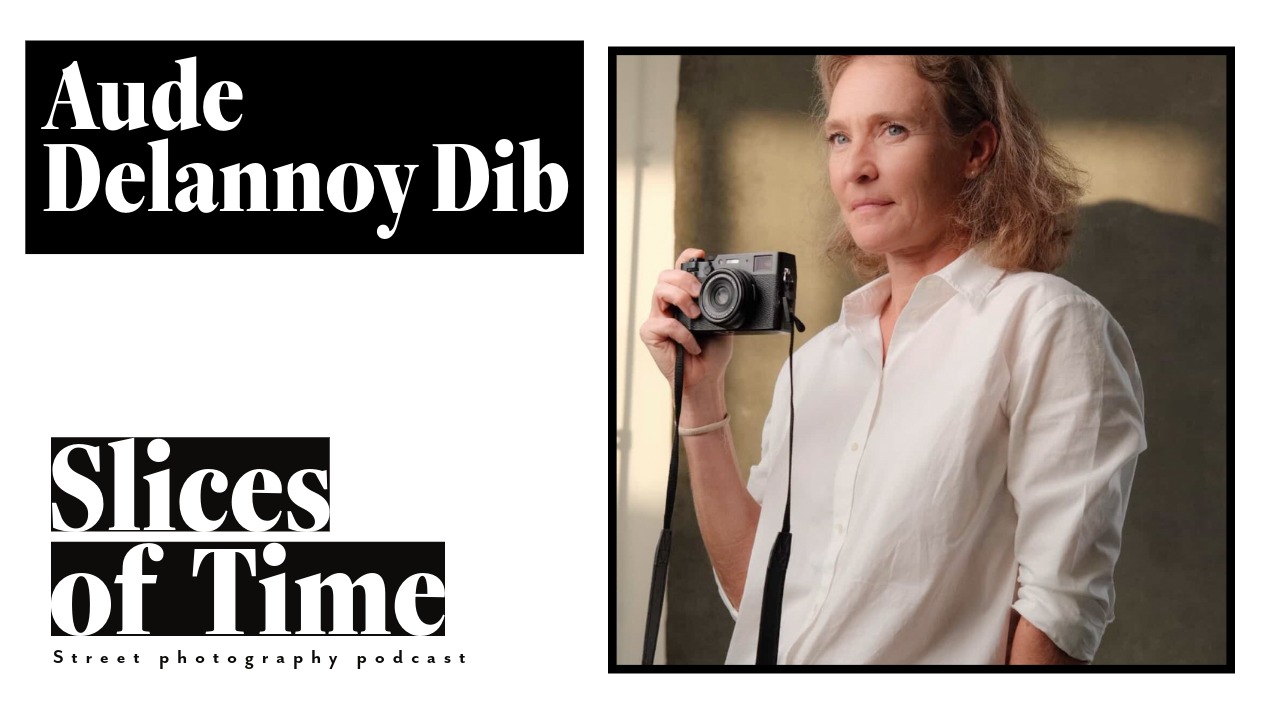
Today, I’m joined by Aude Delannoy Dib, a street photographer from France living in the United Arab Emirates. Her work speaks to me because of the vibrant, multi-layered compositions.
Follow Aude Delannoy Dib:
- Website: https://audedib.wixsite.com/mabota111
- Instagram: https://www.instagram.com/mabota11
Listen to the episodes on:
You can follow me on several social media for updates about the episodes:
- BlueSky: https://bsky.app/profile/fredpaulussen.bsky.social
- Instagram: https://www.instagram.com/fredpaulussen/
- My website: www.fredericpaulussen.be
Timestamps of this episode with Aude Delannoy Dib
00:00 Introduction to Street Photography and Aude’s Journey
05:54 Transition from Painting to Photography
12:00 Navigating Street Photography in the UAE
17:55 The Art of Composition and Framing
23:53 The Importance of Education and Feedback in Photography
28:34 The Evolution of Photography Appreciation
29:08 Camera Choices and Technical Considerations
31:11 Editing: A Necessary Evil
33:40 Capturing Emotions Through Photography
38:36 Creating Series: The Art of Cohesion
43:06 Embracing Limitations as a Source of Creativity
46:47 Daily Photography: Finding Rhythm in Constraints
Photographers, resources, and gear mentioned in this episode:
My personal takeaways from talking to Aude
- Get busy with working your scene and adding complexity to it. Add another element; see if you can find complementary colors and build upon what’s already there.
- When giving and receiving feedback, the “why” is very important, as it helps you improve beyond just critique.
- Having restrictions helps you, but you need to take those restrictions (like bad weather in Istanbul) head-on
Thank you for listening to this conversation with Aude. Don’t forget to subscribe to be updated about upcoming episodes. Feel free to reach out via social media if you have any questions or ideas you’d like to share.
Don’t miss any episode by subscribing to the podcast on Spotify!
Podcast Transcript
Frederic Paulussen Welcome to the Slice of Time Street Photography Podcast. A podcast in which I explore the work of different street photographers across the world, genres and visions. This of course is to expose ourselves to different ideas, ways of looking and helping you and me to form our own vision of street photography. Today I’m joined by Aude Delannoy Dib, I hope I pronounced that right. A street photographer originally from France, but living in Dubai.
Aude Delannoy Dib Correct.
Frederic Paulussen The work spoke to me because of the vibrant and very multi-layered compositions with a lot of colors, I think we’ll be talking into that. Maybe Aude you could introduce yourself for a second there.
Aude Delannoy Dib Good morning, Frédéric. Thank you so much for having me today to talk about photography, my favorite subject of all subjects, I think. Introducing myself is probably the most difficult question. It’s the question you never prepare to answer. Originally, I’m French, but I was lucky enough to live in different countries all along my life. It started with South Africa as I was a baby, and then as a teenager, we moved as a family to England for a couple of years, and then I was back in France to study. I think those experiences living abroad led me to choose to study business because I thought it would be easier for me to work abroad.
When I started my working career, I started in Paris, but then I moved to Milan for a couple of years. I worked in corporate business for many years before I moved to London to be with my future husband. There I stopped working and decided to do something completely different that I always wanted to do but had put aside, which was to apply for an art school. The UK has something that at the time was really great, whatever your age, you could always apply to study somewhere. At the time I was about 28. I did a foundation course and applied to art schools, and three of the main London art schools accepted me. I decided to do a BA in painting at Chelsea Art School. I dedicated my life to painting for many years until I had my three children. I was painting on very big canvas and very colorful, but it took a lot of space and a lot of time. With three children, it became unmanageable. My husband pointed out that we had messy paintings and paints everywhere and I had to do something about it. I decided to quit painting and take a camera instead.
First, it was to document my children. I needed an artistic way to express myself, so from painting, it shifted to photography. Just photographing my children wasn’t enough for me, so I had to imagine scenarios in which they were playing an act so I could take pictures of that. I did this for many years until they became teenagers and said they felt exposed and didn’t want to do this anymore, worrying about their friends seeing it on social media. They put an end to it, and it coincided with the time we moved as a family to the UAE, in Abu Dhabi first. It was in 2016, 10 years ago. I asked myself what I should do now. I took my camera and went in the streets, which wasn’t an easy choice because in the UAE you’re not allowed to take photography of people without their consent. Ideally, they say you should have consent forms in your backpack and each time you take a picture of someone, you get them to sign the form, which is not really the spirit of street photography.
I started photographing with less people in my composition because I was really afraid and got told off so many times by security people, which kind of puts you off. I decided to go to industrial areas where there were still security people, but the people in the street were workers and didn’t really mind me taking pictures. I explored different areas in the UAE and found that in Dubai, people were more relaxed in certain areas. I started traveling to Dubai to take photographs, and in 2019, we actually moved to Dubai. That’s where my street photography really started to pick up. I would go to very old areas of Dubai where people didn’t mind being photographed. It was easier for me to try to do something in the streets. I don’t know if I’ve really been talking about myself; I’ve already started talking about photography.
Frederic Paulussen We’re going to talk about your photography, so you’re an essential part in that. To me, it’s interesting, did you do any photography during your painting phase already, or was it a hard pivot?
Aude Delannoy Dib It was a hard transition. I didn’t really take any photographs. That wasn’t something I was doing. I remember asking my husband to buy me a small camera so I could take pictures of the children so we wouldn’t miss those moments because they were growing so fast. My first camera was very basic, something very cheap. I didn’t care about the results of what I was taking. It was more to document something. Then it evolved into a more artistic practice with time. But that wasn’t the aim at first.
Frederic Paulussen I don’t know your paintings, but I can easily imagine your street photography being influenced by your painting style, because it’s very colorful and well layered. You have these lines of surfaces in every photo. Is there a lot of geometry?
Aude Delannoy Dib There’s a lot of geometry.
Frederic Paulussen Exactly. That’s what I tried to say but didn’t find the word. Was it something that came from your paintings as well, or is it a totally different style?
Aude Delannoy Dib It’s totally different. My paintings were figurative. I was making portraits of people, and only that. I had a hard time inventing a background because the main focus was the subjects. I remember in art school, they were always telling me, what about the background? I said the background doesn’t interest me, I’m only interested in the people. Now in photography, it’s completely the opposite. The people in my photographs are not the subject. The subject is the background, the foreground, the middle ground, the geometry. The light, of course, is the subject of my photography, and the color, but not the people anymore. It’s a complete shift to what I used to do in painting. What remains is the color. Color is always center stage in my photography, as it is in my painting. I’m still painting and drawing today, I haven’t quit. That’s what I took from painting: the color and probably the composition as well.
Frederic Paulussen Because it’s fairly similar, I assume the ideas and rules in painting and photography are related.
Aude Delannoy Dib You have a white rectangular canvas, like a frame in a picture, and you need to fill it in. That’s probably why you’re telling me that. Some people tell me my frames in photography are very full. There are a lot of things everywhere. I think it comes from painting, where you feel you need to compose, balance, and have the eye go around the painting. There are always little things that attract the eye, and I try to do the same in photography.
Frederic Paulussen I had a question written down about how you have a very up-close approach. You go really close into your subjects, filling your frames. I wrote down “not into minimalism,” because your frames are very full and colorful. I really appreciate it, but it’s not easy to do or easy to spot. Lots of elements ask for lots of attention. I can imagine your photo walks being mentally exhausting after a while because of all the things you try to organize. You started out in Abu Dhabi with street photography, which is immediately a very restricted place to do that genre. I imagine you got a really quick course in how to maintain yourself and behave in the streets. Because you also go to other places, did those places become easier for you?
Aude Delannoy Dib There are many questions in your question. Before I answer them, you were talking about it being mentally exhausting to compose a picture. Actually, it’s the contrary. I go in the street to relax and empty my mind. As I empty my mind, I fill in the frames. It’s not exhausting; it’s a game for me. When I enter the street, there’s always something that’s going to captivate my eye, probably a color, a shadow, or something. As I get closer, I try to imagine what I can put in the frame. I try to move so I can get as many things as possible in that frame to make it complex and interesting. If I can’t fill the frame, usually I leave the place and try something else. It’s not exhausting for me, it’s emptying my mind and it’s a game.
To go back to your question about the restrictions. The first years I was photographing in the UAE, there were a lot of restrictions and the fear of being caught and told off. I wasn’t always going in the street with a light mind; I was afraid of what could happen. This probably taught me to master my fear. Nowadays I go very close to people because I’ve been used to doing things I’m not supposed to do. It’s not easy to go very close to people because you never know what their reaction is going to be. That’s what you fear the most. But with time, you experience that when people notice they are being photographed, they will glance at you with interrogation. It can be interpreted as anger, but as soon as you smile, wink, wave, or say thank you, 99.9% of the time, people smile back. It’s just wonder in their eyes. When you show them you’re having fun and nothing important is going on, people are really relaxed about it.
You mentioned traveling abroad. When I decided photography was important to me, I realized I couldn’t self-teach all the time. I needed to be taught properly, even the part of editing my photos or where to download them. Through Instagram, I met a guy who seemed to attract a lot of very good photographers and organized workshops mainly in Asia, Maciej Dakowicz. I decided I needed to do a workshop with him. I found a spot, which took a couple of years because he’s very popular, and I went to Lahore in Pakistan for the first time with him. He taught me the basics of street photography, not just how to frame, but what to do with your SIM card, how to use Lightroom, name photos, order them, and give them stars. It helped me a great deal. Going to countries you don’t necessarily think you can go on your own as a woman, like Pakistan, he helped me navigate. Now I would go on my own without any problem. Since then, I go every year on a workshop with him. This year was in Bangkok, the year before was in Bangladesh. This helped me a lot to become a better photographer, widen my knowledge, and understand how to react in the street, how to frame, and what to do with my photos afterwards.
Frederic Paulussen There’s a lot of information in there. I find it interesting to see where people take some questions. Two things came up for me. First, you mentioned you start filling your frame and looking for all these elements. Do you take the pictures meanwhile, or is it more like a painting where you make your composition first and then take the one shot? With paintings, you can’t make a hundred canvases for one final painting, which you can do with photography. Are you very selective with your shots, or are you an overshooter like me?
Aude Delannoy Dib I try not to be an overshooter. I used to be, but now I’m more picky about what’s happening. I try to fill my frame and have what I like in the frame before I actually shoot. Then there will be the human element passing through, which is usually the finishing touch. This can take a lot of time, waiting for someone to cross the frame. Before, I would shoot whomever entered the frame. Now I’m very picky. It needs to be in the color palette I have, or it needs to be a specific subject. If I compose a scene, I compose the frame and wait for something to happen. I’ll start to shoot when someone crosses, but I’m not going to take five photos of that person crossing, just one. I might stay half an hour in the same spot and shoot different people who cross that frame.
While I’m doing so, I force myself to put down the camera and ask, what can I include more in that framing? What angle is better than the one I currently have? Most of the time, you can always bend down, add something, or take something out to make your photo better. It’s an exercise. I try not to stay static and think everything is perfect. You have to move and try to include or exclude elements. It’s like in painting, you have to try. You can’t say, it is what it is, it’s perfect, I’m not touching anything. Dare to do something completely different. Dare to destroy the composed image you have and try a new angle. Sometimes it works better, sometimes it won’t work at all and you realize the first composition was best. Just don’t get stuck in one place and don’t overshoot. Think more before shooting. That’s what I try to do.
Frederic Paulussen To me it’s interesting because recently I’ve found myself stuck between these rules. You said to compose more and think about it in advance. Other street photographers are more intuitive and just choose the action. You’re both correct. As a street photographer, you have to listen and find what works for you. For me, it helps to force myself to slow down a bit. I’m a person who won’t wait at a spot for two minutes; that’s already long. Hearing you say half an hour in one spot is crazy to me, but it does help me to try five minutes in one place. I usually get a better shot than if I just walked past and took it quickly. It’s very interesting that you found what works for you.
The second question I had was about the workshops you follow yearly and going to art school in London for painting. Do you find it necessary or important to have an education, whether that’s an actual school or workshops? Do you think that helped you advance quicker or further than you could have done yourself?
Aude Delannoy Dib I do. It’s not really education; it’s exchanging with people who have the same mindset as you. Nowadays it’s easy because through the internet and Instagram, we meet so many people. Before, we were just on our own in the practice and didn’t know if what we were doing was right or wrong. Apart from the books of masters of photography, where you try to replicate or understand what they were doing, you had no one to look at your picture and say why it’s right or why it’s not working.
That’s what I look for when doing these workshops: having someone who, at the end of the day, looks at the ten or twenty best pictures you took. They have the eye and the experience to tell you what is or isn’t working and the reason why. The next day you go back in the street and keep that in mind. For instance, if you get too close to your subject and crop important things, or if you’re too far back and need to step into the scene more, you keep that feedback in mind. It makes you progress much faster than if you’re on your own looking at your pictures and just deciding you like them. You progress if somebody tells you exactly what isn’t working.
It is subjective because everyone sees something different in your picture. That’s why you need to find somebody whose advice you trust because it makes sense for you and you see yourself progressing. I’ve done workshops with other people who didn’t bring me as much as Maciej, which is why I carry on going to his workshops.
Frederic Paulussen A very important point you touch on is explaining why something doesn’t work. Feedback has to be constructive. It has to have a reason, not just “it doesn’t work” or “I don’t feel the photo.” With Instagram, there is a lot of “this is a bad photo” without explaining why. The other way around is also important: “this is a good photo and this is why.” Then you can adjust or continue what you’re doing. Do you take the time to look at your own work and give that critique yourself? Do you say, “I thought this worked at the time, but now it doesn’t, and this is why”?
Aude Delannoy Dib I do this all the time. Every time I come back from a photo session, I need to look at the photos. Some people tell you to let them sit for a while before looking at them, but I’m not that kind of person. I need to look at them first to eliminate all the ones that I think are terrible. I don’t just eliminate them, I erase them from everything I have. Tidying up and reducing the number to something decent is very important to me. The first day I’m quite harsh with myself, and I’m happy about that. I eliminate a lot of photos and select a couple that I think work.
But the next day, or even a week later when I look at them, I might think they don’t work at all. When you’ve just taken the photos, you’re still emotionally attached to them because they are yours. They’re like your babies. A week or a month later, you lose this emotional attachment to that particular moment and you see the photo as it is. You might wonder what you ever found in that photo that was working. A problem I probably have is that I’m always excited about the work I’m doing on a daily basis, but less excited as I see it with time because I judge it more. I tend to focus on the little things that don’t work instead of saying that overall it’s working. I’ll see the small mistake that unbalances it all. It’s probably not a good thing because I can’t really appreciate what I’ve done in the past. I only appreciate what I’m doing today.
Frederic Paulussen That sounds familiar. I come home, edit photos, and the day after I go out again and I’m done with the photos from the day before. I love them, and then I make new ones and love those more. It’s always shifting. We talked a bit about your first camera. Is the camera more important to you these days, or do you still just have one camera with one lens and not care what it is? How do you look at the technical side of it?
Aude Delannoy Dib I’m not going to say that I don’t care. When I started that first workshop with Maciej, I was using an Olympus OMD. He kept telling me I should change because it was eight years old and not good. I was very stubborn and said as long as it’s working, I’m using it. I wasn’t going to change until it died on me. Of course, one day it died on me, two and a half years ago. Then I finally got a proper camera that he was suggesting. He always suggested I should have a Fujifilm camera, so I bought the X100 Fujifilm. It is important in the sense that I need a camera that is reliable and gives me a good quality picture, but that’s it. I have one camera with a fixed lens and I’m not trying to play with different cameras and lenses. I have something reliable, and that’s all I need.
Frederic Paulussen That totally makes sense, and I think it’s a good way to go. I was wondering because you mentioned you weren’t really into cameras, and I think that’s an interesting point. You also mentioned you started using Lightroom during your workshops. Do you enjoy the process of editing your photos, or is it more of a necessary evil? I see you nodding no already.
Aude Delannoy Dib It is a necessary evil. Before I do anything with my photo, the first part is figuring out how to archive it. Do I archive it by date, place, or event? This is important so you can find your work easily when you’re looking for it. Lightroom helps me filter down from 1,000 pictures to just 100 by erasing everything else. When there are a couple that I like, I’ll retouch and enhance the colors and the darks. Just subtle things that enhance the photo. When I started showing my photos, people would tell me I should edit them a little bit because they were too raw. I never really understood what they meant, but now I do. People took the time to explain that you can’t just shoot a picture and send it as it is.
Now I do a little bit of editing, but it’s nothing dramatic and I’m not really good at it. I took a day course on Lightroom and didn’t understand half of what they were talking about. They went into completely changing photos, like turning a pink flower blue or green. That’s not what I want to do, so I shut down on learning those things. Some people like to play completely and do crazy, artistic things in Lightroom, but that’s not what I’m interested in doing.
Frederic Paulussen You can go way too far in Lightroom, but for me as well, I keep it natural and just enhance some things. On your website, I saw you call yourself an observer of emotions. You mentioned earlier that people are not the main subject in your photos, but I think they provide a lot of emotion. Why is emotion so important to you?
Aude Delannoy Dib From the beginning, I wanted to make the distinction between two types of photos. There are photos where you really compose a shot because there isn’t much happening in the street. You find the colors, shadows, and atmosphere interesting, and you want to frame it in an amazing way. That is one type of photo. The other type is when you’re in a place buzzing with people, and things happen right in front of you. It could be a gesture, the way people are dressed, or something crazy happening like a cat jumping onto a plate of food. For this type of photo, you don’t have time to think about framing; you need to be very quick to compose something before the scene disappears in a split second.
These are two different skills, but the first one helps you compose the second one quickly. If you’re used to composing, you’re trained to do it in a split second. You’ll still miss scenes because you might not be prepared or know exactly where to stand, but with practice, you improve. Going into a busy city like Istanbul is amazing for this practice because you dive into the crowd and try to give shape to the movement of the people.
To go back to your question about emotions: I talk about emotions for two reasons. First, I think colors carry a lot of emotions. Every city has a different color palette. Some cities have a lot of grays and blues, which gives a sadder mood to the place. When you go to southern countries like Italy or the south of France, you have a lot of red, yellow, and orange, and the sun is very bright. This saturation also gives a mood and an emotion to the place. I try to capture that. Second, there is the emotion of the people. When you step into a scene with a crowd, you’re capturing the emotion of the moment and the place by recording the cinematic movement of what is happening.
Frederic Paulussen I think you do that brilliantly. On your website, I saw you like to work with series of combined photos. Is that something you’re often thinking about, or do you decide at some point that you have to make a series? How does that process look for you?
Aude Delannoy Dib That’s an interesting question. I’d say both. Sometimes, like last summer, I went to Copenhagen for the first time. I was attracted to something very unusual to me: as soon as there is sunshine, people undress into swimming costumes right on the pavement. They just want to bathe in the sun and be next to the water, which is everywhere in the city. Seeing all these people sunbathing in the middle of the city was unusual. I started taking pictures of that, and when I came back, I realized I had enough pictures to make a great series. I actually want to go back to dive deeper into that subject and make a coherent series.
Another approach happened in Istanbul. Light is my main subject, and after two days, it was just rain and bad weather for the rest of the week. I felt depressed, but I told myself I couldn’t wander around feeling sorry for myself. I needed an idea so I wouldn’t waste my time. I thought of a series doing something I would normally never do: photographing graffiti. The walls of the city have so many layers of people painting, drawing, and sticking things on them. It attracted me when I first arrived, but it wasn’t my main subject. As the weather deteriorated, I decided to work with that. I became obsessed with photographing the graffiti, framing it in interesting ways rather than just documenting it. When I got home, I decided to combine the photos of graffiti with other photos I took in Istanbul that echo them.
Some series I plan in advance and make happen, while other times, I come back from traveling and realize I’ve photographed many things with the same underlying idea and decide to build on that.
Frederic Paulussen I think that’s very interesting. Many street photographers would feel sorry for themselves if it rained in Istanbul. I’m not sure how often it rains there, but it seems you chose the one week where it happened! I kind of like the emotion of the rain, maybe because we have a lot of it here in Belgium, and it shows a certain resilience as people still go places. I find it very interesting that you decided to work with the hand you were dealt. Is that resistance something you often face? In this case, it was the weather, but it could also be the rules in the UAE. You seem to find a way to turn those problems around.
Aude Delannoy Dib My motto now is that limitation is the source of creativity. That’s what I put on my Instagram page. The more constrained you are, the more creative you are, and the less boring your work becomes because you have to think more about what you are doing. Being impulsive is great to a certain extent, but eventually, you repeat yourself. With limitations, you have to think around them to build something. I learned this in the UAE, where not much happens in the street, and even when it does, you’re not allowed to photograph it. There are a lot of constraints, so you have to be creative. Being creative helps you develop parts of your brain so that when you are in a busy, easier environment, you can still apply that creativity. At least, that’s how I feel.
Frederic Paulussen That makes total sense. Do you sometimes give yourself these constraints intentionally? No, you don’t need to.
Aude Delannoy Dib I don’t need to. I have them naturally. You always have constraints. Weather is a big one. I feel inspired and excited when it’s sunny, but seeing clouds drains my motivation. I don’t even want to take my camera out. But when you travel somewhere specifically to take photographs and the weather is bad, what do you do? You have to force yourself to go out and think about how to make it work. At home, I could just not bother when the weather is bad, but here it gets really hot. If I don’t shoot when it’s hot, when am I shooting? The heat is a constraint. You force yourself out knowing there will be no one in the street, and you’re the only crazy person outside. So what do you do? You work on reflections of whatever feels interesting and wait for the one person in the street to cross the frame.
Frederic Paulussen You’re a crazy person going outside at that time of day! Do you try to do street photography daily, or how does your rhythm look?
Aude Delannoy Dib Right now it’s really hard, and going daily is painful. But I had been going daily until about ten days ago because I was working on a project. About a month ago, I returned to a place I love at this time of the year. It’s the only metro station where people actually have to walk outside to get to an area called Business Bay where there are a lot of offices. In all other areas, you use indoor tunnels to go wherever you need to. But here, people have to go outside, which means sunlight and things happening with buildings in the background.
I try to go there around the month of May every year. This time, the place had completely changed because they are building new structures. The background of my photos were all too similar because of the construction panels. I had interesting characters crossing my frame, but the pictures looked the same. I worked on a project of isolating the person by darkening the background to black in Lightroom, allowing the subject to stand out. I went back to that place every day at the same time for a couple of weeks to complete this series. It’s a series of about 30 pages, each a diptych matching two people together. So to answer your question about going out daily: yes, when I can, I do.
Frederic Paulussen That series sounds interesting. Did you start recognizing the same people over and over again each day since they have their rhythm going to work? Was that something that worked for you, or was it another restriction that became annoying seeing the same people?
Aude Delannoy Dib It’s funny you mention that. Because I was going at the same time, I would see the same people. But we’re talking about hundreds of people coming in the same direction within the same hours. You do recognize some because they dress in a specific way or have a distinctive hat. I didn’t mind because if I recognized someone and knew I already had a picture of them, I could shift my attention to someone else interesting. That being said, I have found myself with several portraits of the same person without realizing it while photographing. After a couple of weeks, people were expecting to see me. Many waved at me. I became part of the scene, and they knew they would see me in the evening.
Frederic Paulussen Did you communicate with them about the series, or were they completely unaware?
Aude Delannoy Dib Very few people stopped, because it’s the end of the day and they just want to go home. They cross this place quickly because it’s really hot and people are melting down. It’s a straight kilometer and they want to get it over with. But some people questioned me about what I was doing, and some asked me to take pictures of them in a more formal way. So yes, a few people did, compared to the numbers that actually walked past.
Frederic Paulussen You mentioned the heat. Wasn’t it very hard on you? People wanted to hide from the sun, but you were there in the full sun watching them for an hour or two. Wasn’t that very intense for you as well?
Aude Delannoy Dib It is draining. I would stay at least two hours between four and six. You can’t imagine, I’m dripping, my clothes are completely wet with sweat. At some point, the camera stops working. There’s always a moment when it’s overheating with a red signal, and you have to get it to the shade and wait a bit before going back to it. All those people passing by have umbrellas or wear something to protect themselves from the sun. I’m wearing a hat, but I’m the only one unprotected and staying much longer. It is physically draining, especially at this time of the year.
Frederic Paulussen And you only kept that up for a month?
Aude Delannoy Dib The reason it’s just those months is because the sun goes down very early here. These are the longest days of the year, and it’s completely dark by 6:30 or 7:00. If I go in winter, it’s dark at 4:00 or 4:30 when people start coming out of the office, so I would have no sunlight. The only time of the year I can actually go to that place to see people coming out of the office is in May and June, when the days are longer. It’s the golden hour, so it’s absolutely perfect. In terms of light, it’s the best I can get, but I can only achieve that in May or June.
Frederic Paulussen Working with restrictions again, in this case, daylight availability. I think that’s going to be the lesson of today’s podcast. I’m going to start wrapping it up here, and working with constraints is probably the most important takeaway. Thank you, Aude, for the time and insights. If anyone wants to follow her on Instagram or her website, I will link those in the description. Make sure to follow the podcast for other episodes, and feel free to share this episode with friends who might be interested in the topic and need to work with restrictions a bit better. See you next time.
Aude Delannoy Dib Thank you, Frédéric. Thank you so much.