
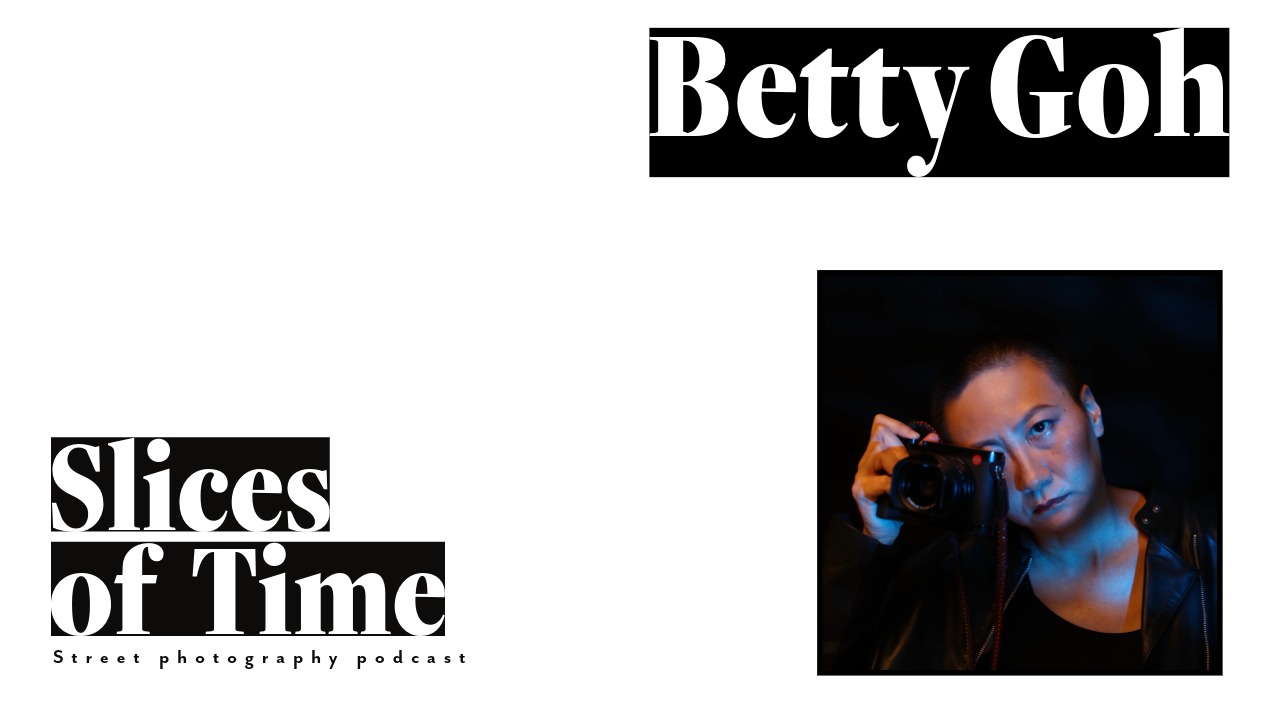
Today, I’m joined by Betty Goh, a street photographer from Singapore. Her work speaks to me because of the very dynamic shots she makes.
Follow Betty Goh:
- Website: https://www.bettygohphotography.com/
- Instagram: https://www.instagram.com/betty_goh_photography/
Listen to the episodes on:
You can follow me on several social media for updates about the episodes:
- BlueSky: https://bsky.app/profile/fredpaulussen.bsky.social
- Instagram: https://www.instagram.com/fredpaulussen/
- My website: www.fredericpaulussen.be
Timestamps of this episode with Betty Goh
00:00 Introduction to Betty Goh and Her Photography Journey
08:01 The Evolution of Betty’s Photography Style
19:41 Finding Inspiration in Everyday Life
25:00 The Importance of Solo Exhibitions
30:00 Curating Personal Stories Through Photography
31:07 Personal Journey in Photography
32:49 Finding One’s Unique Style
34:59 The Evolution of Artistic Expression
36:30 Authenticity in Photography
38:34 The Art of Printing and Presentation
40:49 The Challenge of Publishing a Book
43:14 Solo vs. Community in Photography
46:25 Standing Up for Oneself
50:37 Contentment in Artistic Pursuits
Photographers, resources, and gear mentioned in this episode:
Thank you for listening to this conversation with Betty. Don’t forget to subscribe to be updated about upcoming episodes. Feel free to reach out via social media if you have any questions or ideas you’d like to share.
Don’t miss any episode by subscribing to the podcast on Spotify!
Podcast Transcript
Frederic Paulussen (00:00)
So welcome to episode 23 already. Today I’m joined by ⁓ Betty Goh, originally from Singapore, but now she’s in Beijing, I understood, for an exhibition. And I wanted to have her on because ⁓ her work spoke a lot to me because, well, first of all, it’s very ⁓ dynamic, all the photos, but also it feels… ⁓
very personal, maybe even more so than most street photographers. So that’s why I wanted to have ⁓ Betty on the podcast. So, hey, Betty, ⁓ maybe could you shortly introduce yourself?
Betty Goh (00:34)
Hello.
Hi, I’m Betty and I’m born and based in Singapore. ⁓ So I’ve started street photography around 2018 and ⁓ after that over the last few years my style has evolved and ⁓ I kind of… ⁓
feel that I have my own style and I call my own style as a subconscious ⁓ style and this subconscious style is more like an abstract street photography. It’s still street photography but photographed in the abstract manner and ⁓
I feel that I also have a signature style which is also difficult to explain unless you see my photos. ⁓ Today I’m in Beijing. I have a solo exhibition here and it went well. In fact, today is the last day so I’m sitting here in the gallery talking to you.
Frederic Paulussen (01:37)
⁓ okay.
Yeah.
Yeah, there’s no video of course, but for the people listening, there’s like a big wall behind Betty with all of her work of course, because it’s a solo exhibition. I think a solo exhibition is like the best kind of like you have group exhibitions, which is of course fun and you can make many connections. But I think like a solo exhibition is very something to be very proud of. And as you said, yeah, you have a very distinct style. indeed mentioned this subconscious style on your website as well.
And to me it’s like, yeah, you have abstract photography, for a lot of people maybe they’re thinking about kind of like Saul Leiter as well, which is kind of more abstract. But for you, it’s entirely different. It’s also more dynamic. It’s very much. Well, it’s not all ICM, but there’s a lot of movement in your photos. So yeah, you mentioned about your style evolving in the past, which is it seven years now then?
⁓ How did that go for you? How did you find this style quickly and just had to fine tune it or was it really like you went all over the place and eventually ended where you
Betty Goh (02:42)
Mm-hmm.
Okay,
so I will say from the beginning how actually photography started. actually started, okay, so far in my life, right, I have been like a typical Singaporean who has been like going for studies and then pursuing studies and also doing the financial or banking ⁓ jobs as what is expected of a Singaporean.
So I did that and because of the, to pursue all this career. ⁓
or probably it’s because of the society expectation. There’s no time to find any hobbies. So I do not have any hobbies for almost half of my life or more than half of my life. So in 2016, I had a little problem with health. So I went to see a doctor and he took something out from me. And fortunately, there was nothing serious about it.
That incident made me think about my life. I suddenly feel that life is so vulnerable that I have been studying and working all my life and I didn’t have time for myself. I didn’t do anything for myself. I do not have any hobbies. So I start to think that I need to find something that I like. So I tried to pursue a few hobbies but because of my
⁓ travelling because business trip schedule, I couldn’t join any classes and so after finding some hobbies I decided that okay how about photography because I can do it solo and I can carry just a camera and photograph whenever I want during my business trips. So that was my very starting point of photography. But during that time I could take quite a fairly good
reasonably good photos, but I feel that they are travel photos and they kind of lack of my soul. So I feel just travel photos, beautiful mountains, beautiful lakes, you know, and lovely streets. But nothing really represents me. And so I still feel for so far in my life, I still feel like there’s an emptiness and kind of loss ⁓ of direction in my life.
just
still feel that it’s not me. So, but I didn’t know what it is, but I just continue photographing while traveling and I really love it very much while traveling. ⁓ So then it comes a point where I decided to go to Tokyo for a holiday and I was thinking like what else can I do, what any interesting activities. So I found this advertisement which has a two-day workshop with Siegfried Hansen.
German street photographer. So I signed up without knowing who is he. I didn’t research anything about it. So, but I just joined and very moment that I I joined the lesson, I was truly inspired and you know I was straight inspired because I have never thought that the daily streets can be so interesting because previously I always need to have to
Frederic Paulussen (06:03)
Mm-hmm.
Betty Goh (06:32)
travel to photograph. I always need to find new events or activities before I can photograph. But now, I feel he gave me an ⁓ inspiration that even just within one or let’s say five meters of the street, I could photograph so many things which I’ve never thought about it. So he gave me this very good inspiration.
Frederic Paulussen (06:34)
Yeah.
Betty Goh (07:02)
So this class is just like two days. Okay, and after these two days I was like very motivated and I keep photographing, practicing at home back in Singapore. So then one day I decided to show him some photos to Siegfried. I sent him some photos and then he looked at them and then he just made a simple comment to say that, hey Betty, I think ⁓ you should go towards the direction of abstract street photography.
And I was very, very happy because for all my life, I don’t really get much compliments or anyone praising me. So this is almost the first few praises in my life. So I was very motivated. ⁓ But of course, at the same time, I asked him, so, ⁓ yeah, actually, is abstract street photography? Because I have no idea what he means by that. So then he just said, just do what you’re doing.
Frederic Paulussen (07:55)
Yeah.
Betty Goh (08:01)
now. So okay, okay, it’s easy because I know what I’m doing so I just keep practicing, practicing and then and yeah so I just keep doing and then in 2021 I was diagnosed with cancer and then I was initially of course depressed because of this and
But then later on I decided that okay I should not be depressed and what can I do to encourage myself. So I decided to buy a new camera because my old camera is just a simple one and it’s almost like damaged. So I bought a new camera and I tell myself every day ⁓ I should go and ⁓ take some photos on the streets after each day’s hospital visit because during that time I need to go to
the hospital for radiotherapy every day. So I did that. I photographed the streets every day after the radiotherapy. ⁓ Even though I’m not supposed, I mean, the doctor warned me not to go under the sun because during that time was like real summer time, that August. Yeah, so it was really hot. ⁓ But ⁓ they say that because under the radiation, you know, should not go further, more
radiation under the sun. But you know I just go again, I was a bit rebellious because I really feel that photography can bring me joy and I should not just like ⁓ just go back to my house my room and go back to my house and face the four walls again alone you know so I want to do photography so I did that and I keep going to the same street because it’s just near the hospital right so I keep going to the same street so slowly I start to ⁓
like find some interesting things on the streets every day.
And then slowly, slowly, the photos start to evolve and then I start to kind of think that my style is kind of growing. And when I look back, I feel that my photos are kind of introspective. That is like reflection of my inner soul, which is not just for the cancer period, but from young, how I felt from young about the world, about the city ⁓ up to now. So yeah, so that’s how
the photos evolved. yeah, even during that time, the photos are still quite proper. After that, the photos really evolved. I just do my freestyle. I just feel that I want to express my soul through my camera. ⁓ So the camera is just a tool for me to express my soul, but not to be controlled by the
camera. So in summary that’s how it goes.
Frederic Paulussen (11:05)
Yeah.
There’s a lot of questions that popped in my mind. I hope I can remember them all to ask you now. Because it was a very, very good story. Yeah, but it’s also very packed with information. So it’s very interesting, but that’s why I need to make sure that I keep track of everything. Yeah, so first of all, maybe it wasn’t really intentional to go introspective and to have your work to be so personal. That was just something that…
Betty Goh (11:10)
Okay. Okay.
A long story, yeah.
Yeah, just let me know. Okay.
Frederic Paulussen (11:36)
Creeped in or… Yeah.
Betty Goh (11:39)
Yeah, so yeah, it’s definitely not intentional. I just, as I say, during the travel photos era, I just feel that my photos are okay, but they ⁓ lack of my own soul. That’s something I feel. And I just taking photos to kind of document something, right? So it’s just like, it’s beautiful mouth.
Frederic Paulussen (11:54)
Mm-hmm.
but you still enjoy the process
of doing that, yeah.
Betty Goh (12:03)
Yes, I still enjoy
because I discovered, I have to keep travelling, I have to go to Greenland, have to go to Norway to see the Northern Lights. So it’s like, I always have to pursue something new, something interesting in order to photograph. So I keep feeling that I need something to make me happy. So it’s just like some people, keep buying maybe many cameras to make them happy.
but still they’re not happy. that’s it. Yeah, so for me, I keep pursuing something.
Frederic Paulussen (12:34)
Yeah.
Betty Goh (12:40)
So by until then when I finally found my own photography, I feel that I found something within me even if it’s a daily thing, a daily routine on just the same place every day. And I find peace and freedom from there. So I feel that there is just something from there because I finally settled down and my
my soul is kind of like it’s free from from its released from there something which is trapped in me for so many years in my life that I feel there is a release in that so I feel that this photo that I’m taking is actually representing me because of that yeah so it’s not deliberate yeah
Frederic Paulussen (13:32)
Yeah,
no, yeah. And was it tough to like publish it? Like for example, you have an exhibition now surrounding ⁓ these photos specifically. it, because it’s so personal, is it hard to show it to people or?
Betty Goh (13:43)
Mm.
Definitely not difficult. Because my style is almost in my photos, all in my photos. So it’s not so difficult. just that I just need to curate in a way that they gel with each other. But it’s not difficult.
Frederic Paulussen (13:52)
Okay.
Betty Goh (14:05)
Because I feel that if you are taking photos because you are, it’s a deliberate intention right, then you will probably, maybe that’s one perspective, that you will feel that you have like, you may have difficulty to curate because you are deliberately doing, and probably your style is like always this and that, this and that, so you may find it difficult to gel each other. But my style is quite consistent and they are all
real me so I don’t really think it’s so difficult to put them together in the show.
Frederic Paulussen (14:43)
Okay, yeah and show it to people. Yeah, okay great. And then do you still do it daily, the photography? More or less.
Betty Goh (14:50)
yeah, because,
⁓ yeah, no, because after the first cancer in 2021, ⁓
Then after that in 2024, had a second cancer. Last year I had my second cancer. And okay, I mean like there was the situation, but I couldn’t go out to take photos for many months. But then when I was released from that, I could take some photos because I resigned from my work, because I work in the financial industry. So I resigned, so I had some time every day.
Frederic Paulussen (15:23)
Okay.
Betty Goh (15:27)
to go and take photos but now I’m back to work again so yeah no little chance again so but I will try to try as much as possible to take some photos on weekends yeah so I difficult for me to take every day nowadays yeah
Frederic Paulussen (15:42)
Yeah, yeah,
with work sometimes it’s, but I hope you’re a lot better now. ⁓ yeah. Yeah, yeah, you’re a very enthusiastic person. Yeah. So that’s always nice. And then, ⁓ so you got into street photography after the workshop in 2018. So let’s get back to that. And so until like for the first few years, you just kind of like,
Betty Goh (15:49)
Yes, yes. You see, I’m so happy now.
Yes.
Frederic Paulussen (16:12)
were just playing around with subjects and techniques or yeah and then you started the more longer shutter speed and reflection ⁓ images. Was it because you, how did you find those or that style? Was it also influenced by other photographers looking at work or was it just by playing around with the camera on a regular basis and stumbling upon that technique?
Betty Goh (16:14)
Yes, yeah, correct.
Yeah, so I will say that it’s all like playing, experimenting by myself because what happened is that I feel that, okay, not that I’m being arrogant but I always…
⁓ want to have my own ⁓ mind, you know, when photographing. So I hardly, actually I hardly look at other photographers’ work. I mean, I can look but not study. I don’t really know or like go and research anything. So I, because I feel that photography is a way for me to express myself. So I feel that why I should look at
Frederic Paulussen (17:07)
No, no, yeah.
Betty Goh (17:23)
or study other people’s work such that it is not really real me. Yeah, so I want to be able to have a way to express myself and the way is my way. Yeah, so…
Frederic Paulussen (17:37)
Yeah, yeah, yeah, makes sense.
Betty Goh (17:40)
Yes, because I do not want to be constrained. Because I feel, okay, my perspective is that if I keep looking at some of this work, the tendency is very high that I will want to copy the person’s style, then that’s not your style. Then you may be having difficulty to find your style because you say, this photographer is good, this photographer, how about I try to copy this way, this way. I feel this is for me.
Frederic Paulussen (17:41)
Yeah.
Mm.
Yeah.
Betty Goh (18:10)
don’t think it’s difficult for me to have my own style. So I always maintain that I will always use my own style. ⁓
Frederic Paulussen (18:20)
Okay, great. That’s very cool. And
I’ve heard before also people who mentioned like looking at paintings instead of photography because it’s more…
artistically inspiring and they don’t want to fall into copying someone else. that’s a good answer anyway. And then I can imagine also like going from like travel photography, like you mentioned the Northern Lights in Norway, for example. I can imagine then going to street photography and being able, for example, to do it just in your own street, that it’s kind of liberating perhaps or like it makes it much more easy and accessible.
Betty Goh (18:34)
Yeah.
Mmm. Mmm.
Frederic Paulussen (18:59)
and cheaper probably as well to do. So I can imagine like the world opening up even though you stay more in your own city, no?
Betty Goh (19:01)
Yes, very cheaper Yeah.
Yes, yes. In fact, like, okay, first, economically, yes, it’s much cheaper. Yeah, because last time I really kept like finding new places to go until like, I think maybe I’m going bankrupt because I keep spending so much money on traveling. But then now I managed to find just the street, like just in the regular street, right? So this economically is like, you know, I don’t really have spent so much money except for food because I’ll drink or coffee. ⁓
Frederic Paulussen (19:15)
Yeah.
Yeah.
Betty Goh (19:41)
Yeah,
and then also I feel that the real life is actually the daily life. When we travel, we are like ⁓ something out of the ordinary, right? Of our daily lives. We are pursuing something interesting, like we are trying to find something interesting, extraordinary of our life. But is it our real life? Our true authentic life? Our personal life? No, not really. So I want to look for real…
personal life that I do almost every day and see every day and that is the real life, you know, that I really want to portray that. So yeah, so that’s my style. ⁓
Frederic Paulussen (20:26)
Yeah, and now I wonder
like for example you’re now in Beijing which isn’t your hometown because you’re from Singapore. Do you still manage to make photos you like and find personal because it’s of course a different city maybe I’m not sure how often you get there but it’s not really home so is it still ⁓ easy to get it in your style or?
Betty Goh (20:31)
Yes.
Mmm. ⁓
Okay, mean honestly I still prefer to photograph in my home because like now, okay first of all I’m okay of course I’m very busy at the exhibition okay then if let’s say I have time I probably need to feel something I still need to feel it you know like
Frederic Paulussen (21:10)
Yeah.
Betty Goh (21:15)
If I travel, sometimes I don’t really feel, I don’t know what is that thing in me. Yeah, yeah, yeah, so.
Frederic Paulussen (21:22)
Yeah, I can imagine. Yeah, for me it’s the other way around. But so it’s funny
to hear for you that it’s easier to be in your hometown and photograph there. For me, it’s often more inspiring to go somewhere I haven’t been too often or haven’t been before. ⁓
Betty Goh (21:31)
No. Yes.
Yes, and in fact
many people, like local people, they know of, they also like to travel and photograph but and they feel it’s very boring at home but for me, I find it so interesting at home. I could go to the same place over and over like maybe 1,000 over times.
Frederic Paulussen (21:50)
Yeah, that’s great.
Yeah, that’s great. think like
I do also like photographing in my hometown and going to places at same time, but same time I find it more inspiring to go some someplace else. And so you mentioned the exhibition. Maybe we can talk about that part of your photography because I saw you you’ve done a lot already and there’s more ⁓ exhibitions coming up. Is that something you you
you chase for or how do you have to say like do you actively go looking for galleries to exhibit in or how does that happen for you?
Betty Goh (22:28)
Mm-mm.
Okay,
so apart from group exhibitions, there are group exhibitions or maybe open competitions that I joined, but I still prefer solo exhibitions because I feel that my photos are a little bit different from other street photos. very often, I think a lot of street photo competitions, they actually look for really street photos, candid streets or whatever.
My photos are a bit different, you know. So maybe my photos are difficult too.
gel into other people’s photo. That’s how I feel. So I think usually for group exhibition, as a curator, they want ⁓ something that gels. Photos that have a line, like we have 20 photos, they should have a story to tell, but suddenly there’s this photo that’s out of place. Probably it’s difficult to match. So maybe I don’t have too much chance for street photo competitions.
Frederic Paulussen (23:11)
Yeah.
Betty Goh (23:37)
then I also like for photo art competition that will be good because I feel that mine is more like artistic type of photos. But ⁓ I feel that I like solo exhibitions because ⁓ when I have solo exhibition, the feeling is very different ⁓ when people look at my photos. Because if let’s say it’s a group exhibition and mine is just
⁓ one photo in that exhibition. It doesn’t really tell much about my style or my story or whatever, but when you have a collective ⁓ group of photos that kind of have the same style and they come and haunt you and tell you this is our culture, then people will…
will be able to feel that emotion. Otherwise, if it’s just one photo, they just say, yeah, it’s a nice photo. That’s it. Yeah, they cannot really feel the emotions. Yes, yes. after doing three solo exhibitions, I think this is the real benefit, that people can really ⁓ feel the emotions. Quite a number of people, they come in, they look at the collective group of photos, they say that, yeah, I feel very…
Frederic Paulussen (24:39)
Yeah, it doesn’t tell a story, yeah.
Betty Goh (25:00)
emotion even just like looking at a photo so yeah so that’s very important because photos should not be just photos. Photos should also have a should be able to trigger emotions and yeah so if photo can trigger emotions I think that will be more successful than just a photo yeah
Frederic Paulussen (25:23)
Yeah.
Very true,
It’s funny because ⁓ while we’re talking here, I see in the background people coming into the gallery watching the photos of Betty. So that’s a very fun situation for me because usually it’s like people are like me just in a room.
Betty Goh (25:33)
Yes!
Yes. Yes.
And you know the gallery actually here today is Monday. This art district, 798 art district, is actually closed. Most of the galleries are closed. So we are open. And then even if we are open, it should be till 6pm only. But now it’s already 8.30pm and there are still people walking in to want to see this exhibition. Yeah, so yeah.
Frederic Paulussen (26:00)
yeah. Of course
it’s late for you, me it’s just after lunchtime but of course we have a different time zone so it’s almost… yeah.
Betty Goh (26:10)
Yeah, yeah, I understand. Yeah, but the people
are still interested to see it. Yeah, so that’s why we open late.
Frederic Paulussen (26:15)
That’s cool. Yeah, that’s nice.
That’s very nice. Yeah, and there’s lots of people coming in I see. that’s very, very nice. And so how does this, for example, this ⁓ exhibition go is like you contact the gallery or did they contact you to have like ⁓ your exhibition hanging there or how does that come together? Yeah.
Betty Goh (26:40)
How did it happen?
so coincidentally because I told you I had cancer last year, right? So I didn’t work for like some time after the cancer. So then I’m supposed to start work in June this year. So, but in May, I know that I have to start work in June. So I quickly go for some vacation and be a tourist somewhere. So one of the places I visit is in Beijing. So I came to Beijing and I did
Frederic Paulussen (27:04)
Yeah.
Betty Goh (27:10)
the typical touristic places. And then there was one day I didn’t know where to go and I just Google and then they say, this art district is worth the visit. So I just come here and I just walk for a while and then I saw this gallery with lots of people walking in. ⁓ yeah, so then I just like come in and immediately I stood at the door, the gallery owner and manager they are there. So they talked to me and then
I just mentioned, yeah, I like to take photos and so I showed them my work and then yeah, so then the proposal for the exhibition came. Yeah, so it’s almost like quite a rubbed back. Yeah, so then now I’m here.
Frederic Paulussen (27:56)
Yeah.
That’s very cool, yeah. That’s very
nice. as well, see like you in the background, I see some photos who are like it’s a selection, but they’re not exactly like hung straight. And I like that you did that because it’s…
Betty Goh (28:10)
Mmm. Mmm.
Frederic Paulussen (28:15)
I recognize some of the photos because it’s kind of small from here of course, but I like how you don’t necessarily hang your photos straight as well in your exhibition. Because it’s also like five photos hanging together for the people listening of course, they can’t see it. ⁓ Is the combination and how you hang them, is that something you’ve played around with or how did you…
Betty Goh (28:18)
Yeah.
Frederic Paulussen (28:42)
Did you have small prints which you collaged that way or how did you ⁓ find that idea?
Betty Goh (28:50)
yeah, so basically when I know that we’re going to have this exhibition here, I was very enthusiastic so I quickly came up with my curation of the photos. So I really decided which photos and then what’s the spacing and which wall should we go to. But of course there’s some revision, small revision along the way. And then after that when we did the installation one day before the exhibition,
again there will be some revision and initially this one is not like this, it’s probably like more straight but not like totally straight one line but we have like four photos in one box or whatever so then it’s only during that day of installation we decide to make it a bit fun, yeah a bit interesting.
Frederic Paulussen (29:32)
Yeah.
Yeah.
Okay, that’s cool. Yeah, it’s nice to play around
with. So for example, you don’t have like a set exhibition that travels around because you have some coming up. It’s like you always re-curate your work for the exhibitions or?
Betty Goh (30:00)
Yeah,
so for solo exhibition, will normally, yeah, will, solo exhibition I always curate because I, because I want to know, I mean, I need to tell the story of my photos. Yeah, so ⁓ if somebody decide for you how you want to present the photos, it’s, yeah, it may not tell the true story and also the photos that they choose may not be like what you really liked. There are some people who like my photos or this way, this way, but I still feel
No, doesn’t really say too much. So then I don’t want to choose those photos. So I want to have a say to ⁓ what photos I want to present. But for group photos, of course, there’s group exhibition, then there’s no chance because it will depend on the organizer.
Frederic Paulussen (30:42)
Yeah, of course, yeah. Yeah.
Yeah, of course.
And so we get back to the personal side of it. And I saw you had given some workshops. So I was curious because of course your style is very personal. It’s very, well, your subjects are very personal, your style is very personal. So is it easy for you to like give a workshop because it’s not really something you can just teach someone, I guess. So it’s, yeah.
Betty Goh (31:00)
Mm.
Mm.
Yeah.
Mmm.
Yeah,
so actually the workshop I only did two workshops, then they are like short workshops, like half a day, ⁓ not too long. So like I did it because there was like after the cancer, then yeah, so I just did two small workshops. But after that, nowadays, I feel I don’t really want to do workshops anymore because what you say is because very personal, right? So I feel that like…
Frederic Paulussen (31:43)
No, okay.
Betty Goh (31:48)
If I teach people, they are just like, yeah, yeah, this is how we should do it, right? But somehow I always feel that if you really want to photograph, you should follow your own style. I mean, that’s my personal thing. I always feel that you should photograph in your own way and not follow people. I also feel that nowadays because I’m working, I don’t really have much time for myself, for my own photography. So I want to dedicate the…
Frederic Paulussen (32:02)
Sure,
Betty Goh (32:19)
free time for myself. ⁓
Frederic Paulussen (32:21)
Of course, yeah. And so after
the one workshop ⁓ in 2018, did you follow other workshops yourself? ⁓ Or was that the only one? Yeah. Okay.
Betty Goh (32:29)
to attend other people’s workshop. Yeah, that’s the only one I only attended
one time with Siegfried Hansen, two days and thereafter I’m on my own. So I kind of, I don’t know, self-taught or whatever. But of course he is the beginning, he’s the trigger of, yeah, for my discovery of abstract.
Frederic Paulussen (32:45)
Yeah, but still, yeah.
Yeah. ⁓
Yeah, I’m thinking now as well, like, so you started doing, ⁓ well, it evolved to this very personal style. that something, ⁓ like, when did you find out that it was really like telling a lot about yourself and not just another travel photo, as you mentioned? When did that like click for you?
Betty Goh (32:59)
Yep.
Yeah, I would say maybe around 2022. So 2021, I had my cancer, so then I started to be more involved into photography. And then probably around 2022, I started to feel more into my photos.
Frederic Paulussen (33:38)
Okay. And do you feel that that style is still evolving or do you feel like you found your way of photographing and it’s, well, it’s not, how do you say, static, but of course it’s, is it evolving as quickly as before or is it more slowly now?
Betty Goh (33:58)
Yeah, more slowly, you so it’s like kind of like, yeah, I found my style and then ⁓ I would say that…
Frederic Paulussen (34:00)
more slowly.
Betty Goh (34:10)
Yeah, I think I found my style, but of course you never know because like I feel that ⁓ photography, as I say, if it is really representing your soul, then it may evolve over time because of how your view of life may change.
So maybe last time I may feel very depressed or whatever but maybe in future I feel very happy so maybe I may change my style in the future. So I never know but I do not want to be constrained or I do not want to say that now I’ve done my style, shall I find maybe some masters and try to like see if I can copy his style or make use of his style? No, I do not want, I want it to be natural evolution.
Frederic Paulussen (34:39)
Yeah.
Yeah,
well, now you mentioned the word natural, of course in different contexts, but I also saw your website that you rarely ⁓ edit your photos. Is that because you want to keep it ⁓ as natural as possible or authentic? Yeah.
Betty Goh (35:09)
Mmm.
authentic. Yes.
Yeah, so first of all, of course, to be as natural and authentic as possible. Second thing is maybe I’m lazy. Yeah, because like for example, you just go out, like I said last time, every day I’m going out to take photos. Where have you have time to edit? Like you don’t have time to edit, right? So the next day is another set of work, another set of work. So you just come back by the time you just look at the photo, oh, which one is good, good, good, okay, done, put aside. Then tomorrow you go out again.
Frederic Paulussen (35:24)
Hahaha
Yeah.
Betty Goh (35:46)
right
another one which set okay put aside so yeah so no actually no time to edit and yeah really i mean because i want to produce work like i want my my love is to produce to create and produce work but not to sit in front of computer and keep looking at the thing because my work i work in the this ⁓ financial nowadays i work in like for years last few years i worked in the financial IT
Frederic Paulussen (35:52)
Okay.
Betty Goh (36:16)
So I am really looking at the computer every day. I really don’t want to look at it anymore. I just want to go out the street, enjoy the street, the moment and come back, you know, and I don’t want to sit in front of computer again. ⁓
Frederic Paulussen (36:20)
Yeah.
Yeah, Makes
sense. And so do you like do a lot of stuff in camera already to make sure you don’t have to edit, for example? I’m not sure. I think you’re leica user. Is there like a way like you set the colors, for example, so you just have like the JPEGs ready to go or is that something you don’t, yeah.
Betty Goh (36:42)
Yeah.
No, I
don’t really adjust the camera. So the camera is as it is. ⁓ The most, like when I’m photographing, I just like control the ISO, the shutter speed and the aperture. That’s all I know. If you ask me technical questions about the camera or photography, I’m sorry I’m not an expert in that. Yeah, I’m not…
Frederic Paulussen (36:55)
Okay.
Yeah.
Betty Goh (37:14)
really knowledgeable of that to be honest. So I prefer to use my soul and emotions to photograph because for me the camera is more like a tool rather than a means. It’s just a tool for me to express myself. It’s just a medium for me.
Frederic Paulussen (37:31)
Yeah.
It’s, yeah.
Yeah,
I understand. You want to write on the paper, you don’t want to care too much about which kind of paper you’re writing on.
Betty Goh (37:46)
Yes, So it’s probably
like like even as a painter, I don’t know a painter but I guess ⁓ a painter will probably every painter has almost the same brush but how they express on the paint it depends on their emotions, it depends on the how expensive is the pen right or whoever or brush yeah.
Frederic Paulussen (38:11)
Yeah, yeah,
exactly, yeah. That’s very true. So for example, with that exhibition, like the printing, is it something you just like outsource because there’s a lot of purists, of course, who are like, I have to use this kind of paper and this and this and this. Is that something that interests you then as well? Or do you find that kind of as boring as editing your photos and the printing? Yeah.
Betty Goh (38:34)
Okay, the printing of the exhibition photos? mean,
⁓ yeah, okay exhibition printing of course. I’m also not like…
technical person so I just go to the printer and then say okay I you know you can show me some test print okay and then they show me and of course for my photos they I have a lot of like colors and metallic ⁓ stuff lights and shadows so the whatever paper that they use should should show that because I have ⁓ previously done like I wasn’t knowledgeable about the print paper so when I print like
Frederic Paulussen (39:07)
Yeah.
Betty Goh (39:14)
my metallic colours are really gone, know, it’s like so dull looking. How can it be? Because the real thing is like so shining and so, then, yeah, of course the paper for such paper, it will not be good. So it should have a paper that is like, it should at least show the real thing that I want to show. Yeah, but I’m not like so fussy like say study like this paper is how many grams?
Frederic Paulussen (39:37)
Yeah.
Betty Goh (39:44)
What is the… I have no idea about that. And my test prints are very fast, so just one, two, okay, one, done.
Frederic Paulussen (39:44)
Yeah.
Okay, that’s nice.
I think I would be the
same, wouldn’t like… Or it looks the same or it’s such small differences that it doesn’t really matter to me. And so ⁓ I do see you have ⁓ like a small book about your series. Was it something that you decided on or is it because it’s more of a zine I think as well? ⁓
Betty Goh (40:03)
Yeah, yeah.
okay.
No, I actually don’t really have a book. So, last year, yeah, early last year, I had the zine So Bum books actually produced a zine for me for subconscious and that was already sold out and that was more like a simple ⁓ small zine But after that, no, I haven’t really officially produced a book for myself.
Frederic Paulussen (40:34)
Yeah.
And is
that something you… Okay, because you do a lot of exhibitions. I thought maybe like you don’t really like the medium of a book and prefer to have exhibitions for your work, but it’s just mostly the time or…
Betty Goh (40:49)
I haven’t had the time yet. ⁓
Yeah, okay, first of all, right, I don’t know, I tried to make a book. First of all, I think the printing cost in Singapore is really high because like, yeah, and to make a book ⁓ and then also the…
more troublesome will be more like logistics. Like for example, like if I make a book that’s okay, but then imagine like you have to ship it to like so many different countries. Everybody like this person is from South America, this person is from North America, this person is from Asia, this person is from, wow, this is like…
Frederic Paulussen (41:31)
Yeah.
Betty Goh (41:41)
Like how I don’t have time to do all these things there’s so much administration work so that actually that is the thing that actually kind of puts me off into delay doing a book so unless somebody will do it for me but yes so and yeah so maybe that is the main obstacle
Frederic Paulussen (41:43)
No, no, yeah.
Yeah.
Okay. So if any.
Betty Goh (42:05)
So I
do have requests from so many people that they want to have a book from me but I’m so sorry, really… Yeah, it’s difficult. Not at the moment. Yes! Yes, they should. Yes!
Frederic Paulussen (42:15)
there’s a publisher listening they can find Betty to ⁓ contact her for a book and send me an email when it’s done because
I want it yeah because yeah yeah
Betty Goh (42:26)
Yeah, you see how many people request, know, so if a publisher,
a good publisher will do it for me and like,
Frederic Paulussen (42:32)
Yeah, of
Yeah, yeah, because the zine as you said,
I was just looking into it, but it’s it’s sold out Yeah, so it’s it’s not not
Betty Goh (42:41)
Yeah, even for the zine Bumbook
is the one who manages the shipping and logistics, so I leave it to them.
Frederic Paulussen (42:48)
Yeah.
Yeah,
of course. And so I’m thinking, ⁓ you mentioned the looking for a hobby that you could do by yourself because of course you were traveling a lot and so it was easier to do it, to have something to do solo. ⁓ Is photography and street photography specifically then perhaps still something…
you completely do solo or do you like have a community in like i’m not sure in singapore or or globally that you’re a part of or
Betty Goh (43:26)
I prefer to do solo. I like to do solo because the reason why I start to be so passionate about photography is because I can express myself through the photography.
When I’m in a group of people, I don’t feel myself. I feel like I’m trying to oblige to people, trying to socialize and all these things. So I feel I don’t really enjoy photography when I’m in a book group. Yeah, so I prefer to do solo when I’m photographing.
Frederic Paulussen (44:03)
Yeah, but also just for like
for example for conversations for example I have ⁓ a group here in Antwerp that I organized ⁓ monthly and it’s just we don’t take photos together we just meet at a coffee bar and sit there and we talk it’s usually about photography but it can also be about random stuff but it’s not that as if you’re you’re really looking into like just
people to have conversations with as well or it’s really like something you try to keep solo and private, not really private because of course you publish your work but ⁓ to yourself or…
Betty Goh (44:43)
The reason why I like photography is because I like it because it helps me to express myself and I feel that I can feel the world around me and all those things. So talking about photography is not really me. I feel it’s just talking talking. Maybe I’m so not really love talking.
Frederic Paulussen (45:06)
Okay.
Yeah.
Betty Goh (45:13)
you
Usually, maybe I’m more practical person. When I want to do something, I feel that it should be worth my time to do it. I feel that time is really not enough for me. I don’t have enough time, so I want to do what I love to do. Because last time, from young to before I found photography, I feel I’m always like,
Frederic Paulussen (45:25)
Yeah, of course. Yeah.
Betty Goh (45:44)
trying to adhere to people’s obliges, like oblige to people, trying to be like to the society, you know, whatever, okay, say all this, you need to do this, you need to do that, so I just keep following to do it. I don’t find myself, so finally now I found photography. ⁓
that can, you know, it’s very personal. I feel that it helps me personally. I don’t want to again go back to a place where I have to keep obliging to people. Yes, so I mean, just to be very honest.
Frederic Paulussen (46:12)
Yeah.
course.
Yeah and do you find now that ⁓ you have that insight of not wanting to please other people, did that evolve in other parts of your life as well? did photography cause an evolution in your life in how you view ⁓ your work, your relationships, your… ⁓
your family, your, I don’t I’m not sure, like, did that like have an effect or does that make sense, that question?
Betty Goh (46:58)
Yeah, so,
yeah, I mean, I understand. So, yes, I mean, like, kind of, I want to stand up for myself, you know, so I feel that sometimes, yes, apart from photography, ⁓ I also like stand up for myself if I find that the certain… ⁓
stuff are not worth my time. Sorry to be so arrogant but it’s really not worth my time. Like for example, ⁓ okay just talking about it now in Beijing right in this exhibition.
I have ⁓ so many visitors who want to come to my exhibition. I’m really very busy at the gallery. But then there was one interviewer, she wants to come and interview me. She did came and interview me and then she was ⁓ more concerned about the cancer, women’s cancer. So she wants to talk about that topic which I spent originally was just one hour interview but in the end,
Frederic Paulussen (47:53)
Mm.
Betty Goh (48:01)
I spent almost the whole day talking to her. was like, okay, so in the end, she goes away. And then that day she called me again and said, oh, yeah, can I come to the gallery and interview you again? I was thinking like, okay, I need to draw the line now because I’m here, especially I fly into Beijing for the exhibition is to meet my people who want to see
Frederic Paulussen (48:17)
Okay.
Betty Goh (48:31)
my exhibition.
but not to keep obliging people to interview for their work. I have really spent one whole day, I lost one whole day to oblige to them, but I really cannot spend too much time ⁓ further. So that’s why I say no to her. I do feel bad about it, but I see sometimes we need to stand up for ourselves also.
Frederic Paulussen (48:50)
course.
Yeah.
I understand, yeah I understand,
it’s a lot of time. After this recording I won’t bother you too much, I will still… No, but I get what you’re trying to say, yeah. And so, yeah. And so before you wouldn’t have… So before discovering yourself through photography, you wouldn’t have dared to draw that line and you would have welcomed her again, you think, or?
Betty Goh (49:07)
No, no, no, no, I mean like, yeah, yeah, yeah, one whole day, you know, is really so important, yeah.
Yes, I will have a lot of concerns like, do I offend her? I feel very bad offending somebody. now…
Frederic Paulussen (49:38)
Okay that’s fun so it really helps
you be yourself more yeah and protect yourself more.
Betty Goh (49:45)
Yeah, and I feel,
yes, I feel better, you know. I feel like I’m standing up for myself because I used to be being bullied for, for, for easily, you know. I’m more like soft spoken, so I feel I always being, often being, make use or bullied by people. So I want to stand up for myself.
Frederic Paulussen (50:05)
Hmm.
Okay, yeah,
to me you come across as a very happy, ⁓ enthusiastic, authentic person. it’s, of course, I don’t know your history, so it’s hard to see for me now that you would be that kind of person. ⁓ And so are there, I sometimes ask it and I kind of know the answer already, but I still wanna ask the question. Do you have like a,
Betty Goh (50:25)
Mm.
Mmm.
Frederic Paulussen (50:37)
wish list of places you still want to photograph. We already kind of touched this of course but…
Betty Goh (50:43)
To
photograph, ⁓ okay, I don’t really have a wish this because as I say I’m quite contented with where I am but of course if I have a chance to
Frederic Paulussen (50:51)
Exactly.
Betty Goh (50:56)
Should travel somewhere, of course, good. ⁓ But I prefer to go to the cities, like urban cities, because that is something I wish to photograph, continue to photograph. ⁓ But I don’t really have any plans. Yeah, so I just take it naturally. Yeah, if I have a chance, I will have a chance. Otherwise, I’m always contented with where am I.
Frederic Paulussen (51:19)
Yeah, of course.
Yeah, yeah, because you mentioned already that you very much enjoy just photographing in Singapore. That’s your preference. I kind of know the answer. And so maybe because to me, of course, I’ve never been to Tokyo or Singapore. Was it easy for you to because sometimes ⁓
a place kind of dictates your photography. So for example, if I would be in Tokyo, I would be more… My photography might be slightly different than I would in Belgium. Did you find that easy to translate after workshop in Tokyo then to come back to Singapore and ⁓ keep that… keep yourself and your style ⁓ or translate the information you got from that workshop into your own city?
Betty Goh (51:59)
Definitely. Yeah.
It’s a bit different but still ⁓ okay. It’s still like not like overly different. ⁓ yeah still like I think still fine yeah because in Singapore
I’ve never really noticed those things when I was in Singapore. Then when I went to Tokyo, I realised that there’s a few things that you can do and look out for, like example reflections and all those things. So when I go back to Singapore, I can also find reflections. So it’s not too difficult. ⁓
Frederic Paulussen (52:55)
Yeah, okay,
okay. Yeah, that makes sense. ⁓ Okay, great. So yeah, I think we can start wrapping it up there so I don’t ask too much of your time. Also, because it’s already late for you, you have to start, ⁓ because it’s the final day of your exhibition in Beijing now, right? So the next one was in Hungary, you said?
Betty Goh (53:05)
It’s okay. ⁓
Yes, yeah, yeah.
no, so this is Beijing is my solo exhibition so I have not planned for a next solo exhibition yet. ⁓ but in end November to early December I have like I was selected for a group exhibition in Budapest because they have this gallery they have like an open call and like it is for their annual kind of annual or biannual like ⁓
⁓
exhibition which ⁓ is quite important for them and I have three photos which will be exhibited there. So yeah that’s in Budapest.
Frederic Paulussen (53:55)
Okay, so if anyone listens to
this episode on a day it’s published, you still have time to make it ⁓ to Budapest and watch some of Betty’s work in printed instead of online, which I find usually is more interesting.
Betty Goh (54:05)
Mmm.
Yes, and I may
possibly be there I don’t know yet. I may have a chance.
Frederic Paulussen (54:14)
No promises, yeah. But maybe. That’s very
nice. it’s maybe, before, like one last question maybe before we wrap it up exactly because now it pops into my mind because I mentioned the printed work or the digital work. Do you have like, do you feel it’s more, even more personal if you see it printed than on a computer screen, for example, or is that not really a difference for you?
Betty Goh (54:23)
Mm.
I think yes the print is like ⁓ yes definitely ⁓
very good because like sometimes you see in a computer and you also wonder right that whether if you print it whether is it as good as it is so yeah sometimes you yeah sometimes a big question for me also so when you see it printed and then it’s good looking good like yeah that’s really yeah sometimes it’s very difficult to tell from the computer screen also i think
Frederic Paulussen (55:10)
Okay.
Yeah, sometimes a photo is completely different if you have it printed even in small, then you see it on the screen. It’s suddenly a different picture sometimes, which is…
Betty Goh (55:28)
Hmm.
Frederic Paulussen (55:28)
Kind of weird to me. So thank you, Betty, for your time, your very interesting insights. Of course, if anyone wants to follow her, I’ll put the links to her Instagram and to her website in the description. Also the link to the upcoming exhibitions because I think that’s very interesting. And of course, also make sure to follow the podcast. If you like the episodes, share them with your friends. That would be very helpful. And new episodes always coming up. So thank you, Betty.
Betty Goh (55:50)
Mmm.
Yes.
Thank you so much, Frederic
2 thoughts on “Slices of Time Episode 023 Betty Goh”